
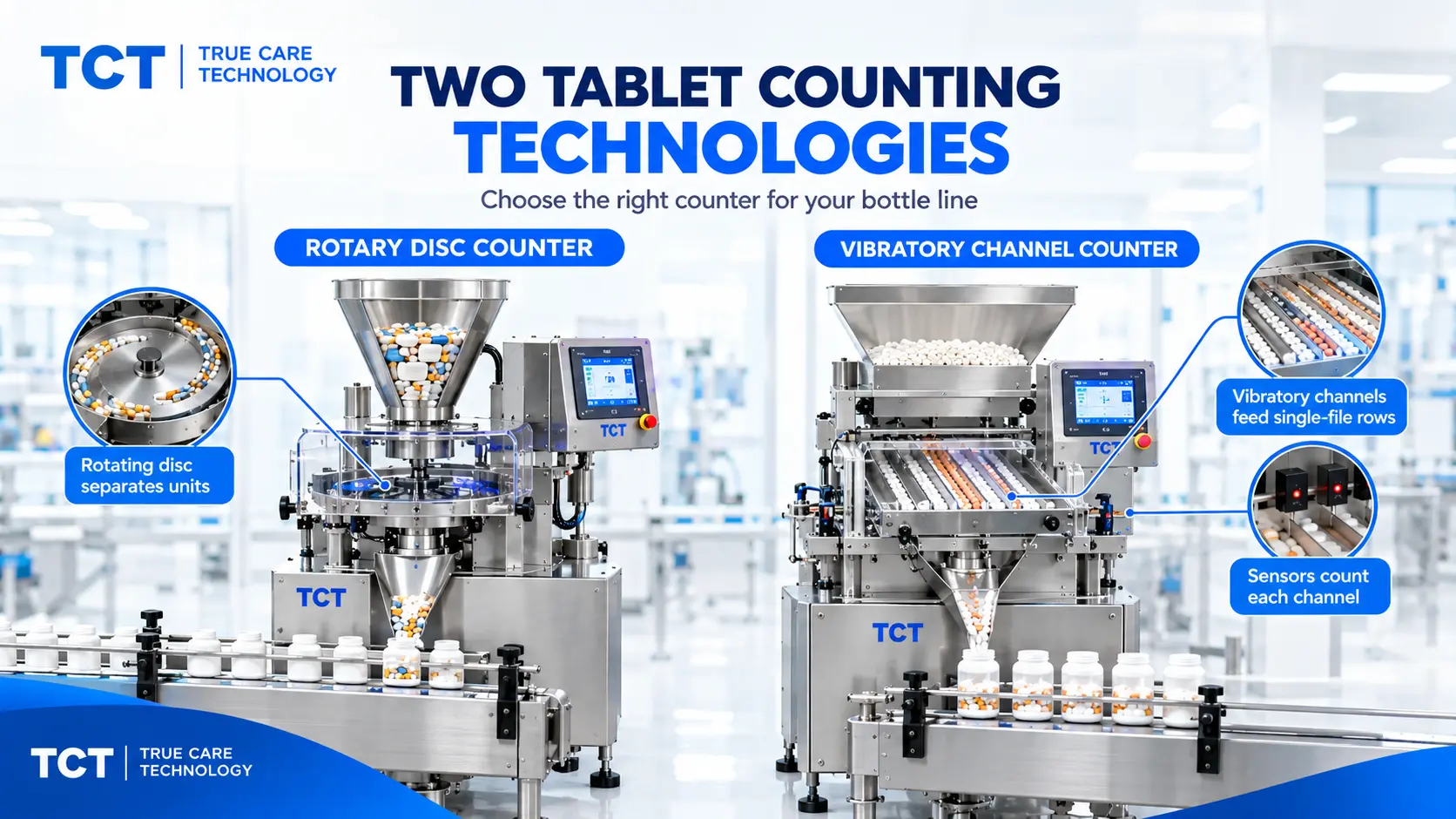
If you fill tablets or capsules into bottles, the counter sets the pace and accuracy of the whole line. There are two common tablet counting machine types: the rotary disc counter and the vibratory channel (multi-track electronic) counter. Both use electronic sensors to count each unit, but they separate and feed product in very different ways. This guide explains how each works, compares them side by side, and shows how to fit either into a bottle line.
How rotary disc counters work
In a rotary disc counter, bulk product is loaded into a hopper and fed onto a rotating disc. As the disc turns, tablets or capsules are separated into single units and guided towards a discharge channel. An electronic sensor counts each unit as it passes, and a gate directs the counted quantity into the bottle below.
TCT's Automatic Rotary Disc Type Tablet/Capsule Counting Machine uses this principle with a vibrating tray feed and a precision counting sensor. Published figures include:
- Output up to 300 pieces per minute
- Tablets 5–12 mm diameter (including irregular shapes), pills 3–12 mm, capsules size 0 to 5
- Bottle neck 25–40 mm, body 39–62 mm, height 39–241 mm, in glass, HDPE, PET or LDPE, round or flat
- "No bottle – no count – no fill" interlock
- AISI 316 contact parts with Ra ≤ 0.5 µm mirror finish
Typical use. Small and medium batches, frequent product changes, R&D and clinical supplies, nutraceutical SKUs, and lines where floor space is limited.
How channel counters work
A channel counter (often called a multi-channel or multi-track electronic counter) uses a vibratory tray with several parallel channels. Vibration moves tablets from the hopper into single-file lines, one per channel. Each channel has its own optical sensor that counts units as they fall. Counted product collects in a gate and drops into the bottle when the count is complete, while the next bottle indexes into place.
TCT's Tablet Counting Machine is this type: a continuous counting system with a vibratory tray and sensors that detect tablets of various shapes and sizes. It is offered from the TTC-8Z desktop model up to 12, 16, 24, 32 and 48-channel versions. Published features include automatic bottle-height adjustment, PLC and HMI control, memory for 40 products, tool-free cleaning of contact parts and SS 316/316L contact parts. The TTC-8Z desktop model is published at 10–30 bottles per minute with a fill range of 2 to 9,999 units; larger models scale output with channel count.
Typical use. Medium to high-volume bottle lines, large count sizes and continuous production of a few SKUs.
Matching to product types
Round and oval tablets. Both types handle these well. Channel counters reach higher outputs on long runs.
Coated and fragile tablets. Gentle handling matters. Rotary disc machines are designed to minimise breakage and chipping; on channel counters, vibration amplitude and drop height should be tuned. Trial your most fragile product.
Hard capsules. Both types count sizes 0 to 5 on TCT's rotary machine; confirm sizes for the channel model.
Softgels. Softgels are soft, sometimes tacky and can deform or stick. Neither TCT product page lists softgels specifically, so treat them as a trial-first product. Our post Counting Softgels covers the special handling they need.
Irregular shapes. The rotary disc model is published for irregular-shaped tablets. Confirm the channel model with a trial.
Broken tablets and dust. Fragments can be counted as whole units. Upstream de-dusting and a check weigher or vision check downstream reduce this risk.
Fitting into a bottle line
A counter is one station in a line. Plan upstream and downstream equipment together:
1. Bottle unscrambler or turntable feeds empty bottles.
2. Desiccant inserter (if used).
3. Counter fills the counted quantity. Interlocks prevent filling without a bottle.
4. Cotton or coil inserter (if used).
5. Capper and induction sealer.
6. Labeller with batch and expiry printing.
7. Check weigher to verify each bottle's weight, catching miscounts.
8. Vision or OCR verification of label text and codes.
The counter's output should be slightly above the line target so it does not set the pace. Match bottle heights and neck sizes to the counter's discharge funnel range, and agree the line-control signals (bottle present, count complete, downstream ready) at design stage.
TCT also supplies Tablet/Capsule Check Weighers and online verification systems for downstream checks.
Dust and cleaning
Tablet dust affects count accuracy and is a GMP concern.
- Dust and sensors. Dust on optical sensors can cause miscounts. Fit dust extraction and include sensor cleaning in your shift checks.
- Cross-contamination. India's revised Schedule M, binding on all drug manufacturers from 1 January 2026 after the MSME extension ended on 31 December 2025 (Business Standard), puts strong emphasis on preventing cross-contamination and on validated cleaning. Choose a counter you can strip and clean fully between products.
- Contact materials. Both TCT counters use SS 316-grade contact parts.
- Tool-free disassembly. Quicker cleaning, fewer missed areas. Ask how long a full changeover clean takes.
- Validation support. Ask for IQ/OQ documentation and a count-accuracy challenge protocol.
- Pre-shift checks. Our post 5 Pre-Shift Checks gives a simple routine for counting lines.
Count your product before you choose. Send TCT samples of your tablets or capsules and your bottle. We will run them on both counter types and report bottles per minute and count accuracy. Request a free line assessment or product trial.
Frequently asked questions
Which is faster, rotary disc or channel? Multi-channel counters generally reach higher outputs; rotary disc counters suit smaller batches and frequent changeovers.
Can a tablet counter detect broken tablets? Some can reject irregular items, but a downstream check weigher or vision system is a stronger safeguard.
What bottle sizes does TCT's rotary counter handle? Neck 25–40 mm, body 39–62 mm and height 39–241 mm, as published.