
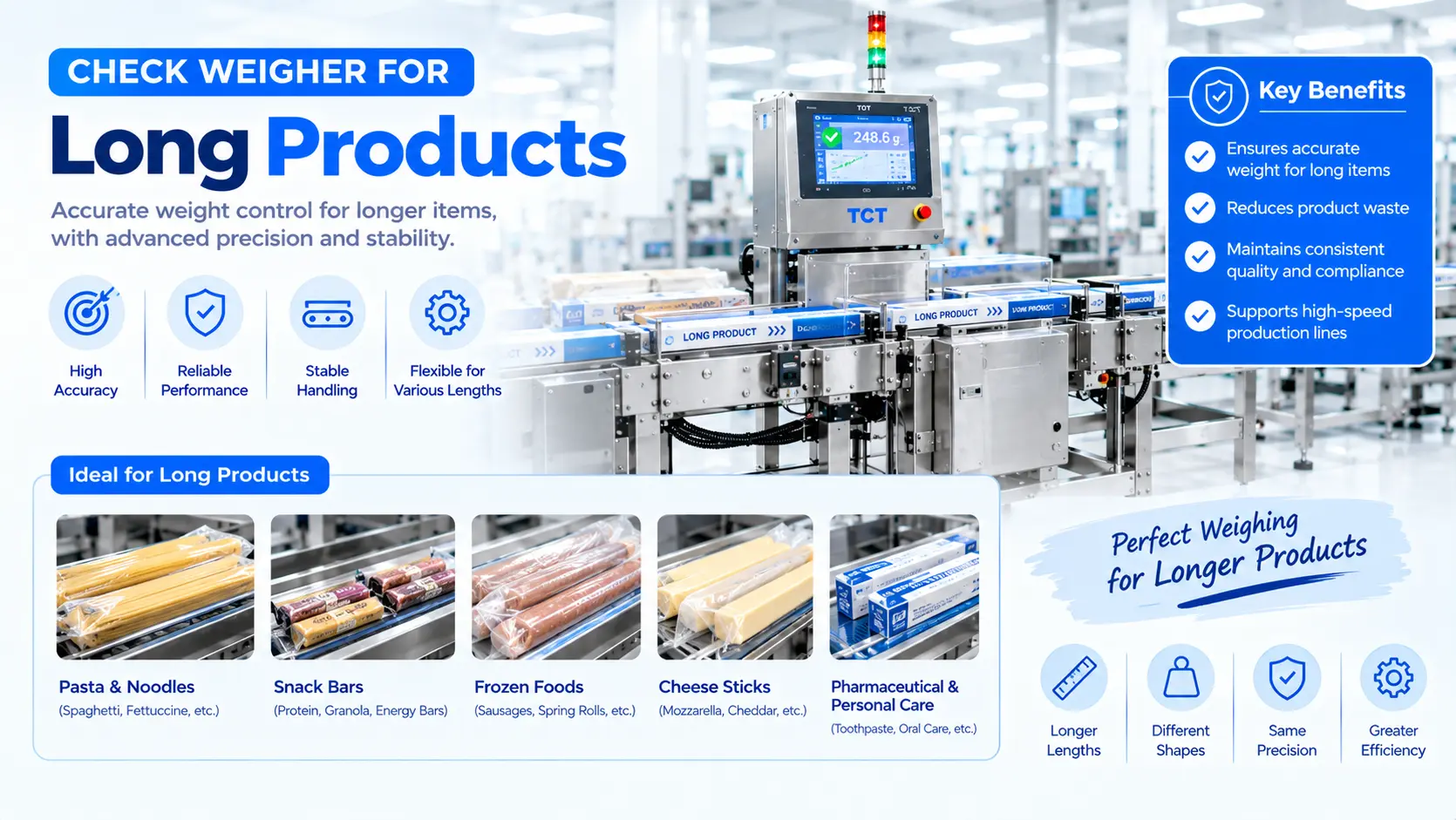
A standard check weigher is designed around a compact pack that sits fully on the weigh belt for a moment. Biscuit rolls, cereal-bar multipacks, noodle bundles, sausages and baguette-style flow-wraps break that assumption. If you choose a check weigher for long products the same way you would for a 100 g pouch, expect unstable readings and false rejects. This guide explains why long packs are difficult, what changes in the machine, and how to set it up.
Why long and irregular packs are difficult
Platform length. A check weigher can only weigh a pack that is entirely on the weigh belt, with nothing else touching it. A 400 mm biscuit roll needs a weigh platform comfortably longer than 400 mm, plus time for the reading to settle. A short weigh belt either sees part of the pack, or sees two packs at once.
Transfer between belts. Long packs bridge the infeed and weigh belts for longer during transfer. While part of the pack still rests on the infeed, the load cell reads only part of the weight. The controller must wait until the trailing edge has fully crossed.
Stability. Long, narrow packs can rock, twist or roll. Bars stacked in a sleeve can shift. Noodle bundles are light for their size and can flex. Each movement adds noise to the reading.
Flex and overhang. Soft flow-wraps sag between rollers or over belt ends. A pack that sags at transfer can catch, skew and arrive at the weigh belt at an angle.
Low weight per unit length. A long pack spreads its weight over a large area, so the signal is smaller relative to the belt's own weight and vibration. That makes good mechanical isolation more important.
Pack orientation and handling
The first decision is whether packs travel lengthwise (long side in the direction of travel) or crosswise (long side across the belt).
In practice, orientation is often fixed by the wrapper or flow-wrap machine upstream. Turning packs only for weighing adds equipment and a jam point. Design the check weigher around the orientation the packs already have, unless there is a clear speed or stability gain.
Design of a long-product check weigher
A long-product check weigher looks similar to a standard machine but differs in several places:
- Longer weigh platform. Sized so the longest pack sits fully on the weigh belt with room to settle. TCT's Online Check Weigher for Long Products accepts packs up to 1,500 mm long and 300 mm wide.
- Wider weighing range. Long packs vary from light noodle bundles to heavy sausage packs. TCT's long-product model covers 20 g to 50 kg with a 2 g division and published accuracy of ±1–10 g depending on product.
- Matched belt speeds. Infeed, weigh and outfeed belts are set to run at speeds that keep packs square and spaced. The TCT model runs belts at 20–80 m/min.
- Smooth transfer plates or small-gap transfers. These reduce sag and catching at belt ends.
- Robust rejecter. A pusher or diverter long enough to move the whole pack cleanly, rather than spinning it.
- Dynamic weight compensation. Software that corrects for the pack's motion and settling profile.
The trade-off is speed. The TCT long-product model is rated at 30–40 packs per minute, which suits most bakery and snack lines that run long formats. If you need higher rates on long packs, discuss multi-lane or line-splitting options during your trial.
Where the revolving check weigher fits
Buyers sometimes ask whether TCT's Revolving Check Weigher is an alternative for awkward shapes. It is designed for a different job.
The revolving (rotary) check weigher handles upright cylindrical containers: vials, eye-drop bottles, aerosol cans, small bottles and cans. Containers travel on a rotating carrier rather than a flat belt, which keeps tall, narrow items stable. TCT publishes a size limit of 10–100 mm diameter and 20–200 mm height, a weighing range of 2–300 g, and speeds of
60, 120 or 180 containers per minute depending on configuration.
So the rule is simple. If your product is long and lies flat, use the long-product check weigher. If it is round and stands upright, the revolving model is likely the better fit. Packs that are neither, such as irregular trays, should be trialled on both before you decide.
Setup tips
- Set spacing from the longest pack. Gap between packs should be at least long enough that only one pack is ever on the weigh belt. Use a spacing (gapping) conveyor if the wrapper discharges packs too close together.
- Calculate belt speed from pitch. Packs per minute × (pack length + gap) = belt speed needed. For example, 30 packs/min × (500 mm + 300 mm) = 24 m/min.
- Do not run faster than you need. Higher belt speed reduces settling time and increases noise. Run at the slowest speed that meets throughput with headroom.
- Fit guide rails at infeed, not over the weigh belt. Rails square the pack before weighing. Rails touching the pack on the weigh belt add friction and distort the reading.
- Shield from air movement. Long packs present a large surface to fans and air-conditioning drafts. Fit the windshield and check for air jets near the weigh belt.
- Zero and check often during the first week. Use a test pack of known weight at the start of each shift until you trust the trend data.
- Run your worst-case packs in trials. Include the longest, lightest and most flexible formats, not just the best-behaved SKU.
Typical applications
TCT's long-product check weigher is used in bakery, meat, seafood and snack applications, according to the product page.
For Indian packs, remember that net-quantity limits still apply regardless of shape. Under the Legal Metrology (Packaged Commodities) Rules, 2011, a 100–200 g pack has a maximum permissible error of 4.5% and a 200–300 g pack 9 g, so the machine's accuracy must sit well inside those bands for meaningful control. Our Check Weigher Buying Guide shows the full table and how to choose accuracy.
Request a free line assessment or product trial.
Frequently asked questions
Can a standard check weigher weigh long packs? Only if the whole pack fits on the weigh belt with room to settle. TCT's standard online model takes packs up to about 100 mm long.
What is the maximum pack length TCT can weigh? The long-product model is published for packs up to 1,500 mm long and 300 mm wide.
Is the revolving check weigher suitable for biscuits? No. It is designed for upright cylindrical containers such as vials, bottles and cans.