
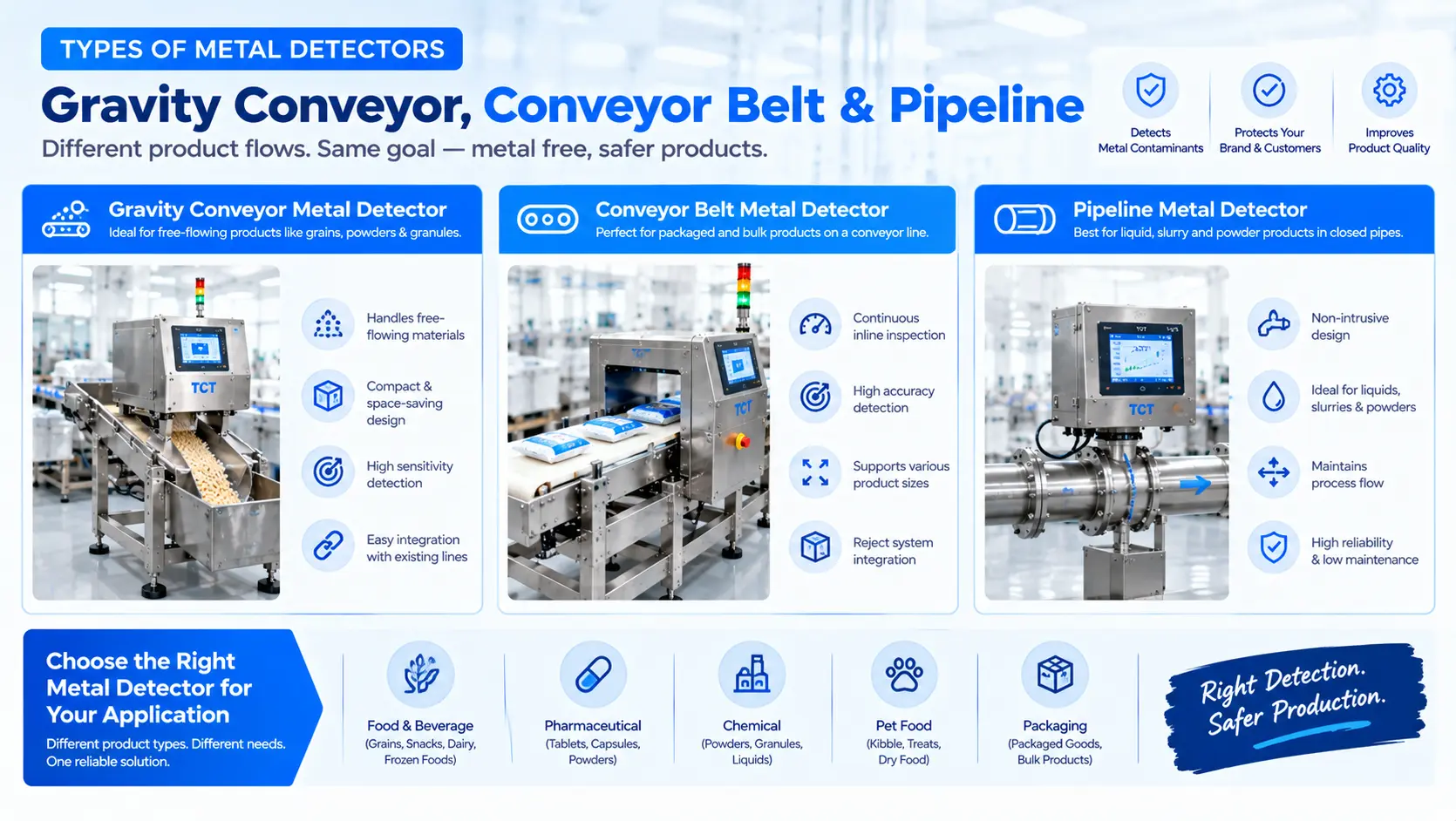
All industrial metal detectors work on the same principle: a balanced coil system whose signal changes when metal passes through it. What differs is how the product reaches the coil. The main types of metal detectors in the food industry are defined by product flow: free-falling (gravity-feed), carried on a belt (conveyor) or pumped through a pipe (flow-through). Choosing the right type is the first step to getting good sensitivity on your product.
The pharma and foil models are specialist versions of the same three basic flow types. The rest of this guide focuses on gravity, conveyor and flow-through.
Gravity-feed detectors
Gravity-feed (also called free-fall or drop-through) detectors inspect dry, free-flowing product as it falls through a vertical pipe. When metal is detected, a fast diverter flap sends a small portion of product to a reject outlet.
Why they work well. Product passes through a small round aperture, so the detector can be very sensitive. Free-fall also means product is not packed in film or foil, which removes a source of interference.
Typical uses. According to TCT's product page: flour, sugar, starch, salt, milk powder, coffee, grains, nuts, seeds, spices, APIs, excipients, intermediate granules and plastic pellets.
Published figures. TCT's TMD-GF70 has a 70 mm inspection diameter, throughput of 6,000 litres per hour, product-contact parts in SS 316, and test sensitivities of 0.5 mm ferrous, 0.7 mm non-ferrous and 1.0 mm stainless steel. Larger variants (GF100, GF140, GF200) handle higher volumes.
Watch for. Product must flow freely and not bridge. Sticky, wet or lumpy product is unsuitable. The reject flap needs a supply of compressed air.
Conveyor detectors
Conveyor detectors are the most common type. Product passes on a belt through a rectangular aperture, and a reject device (air blast, pusher, drop-flap or stop-belt) removes contaminated items.
Typical uses. Finished packs (pouches, cartons, trays, bags) and loose unpacked product such as meat cuts, bakery items, vegetables or confectionery before packing.
Strengths. Very flexible. One detector can handle many pack sizes, and the conveyor can be combined with a check weigher.
Watch for. Sensitivity falls as aperture size rises, so choose the smallest aperture that passes your largest pack. Wet, salty or chilled products create a "product effect" signal that the detector must cancel; this is why sensitivity on real product is lower than on an empty aperture. Metallised films and foil need either a specialist detector or X-ray inspection.
TCT conveyor detector specifications: aperture sizes and sensitivity [TCT SPEC].
Flow-through detectors
Flow-through, or pipeline, detectors are installed in a sealed pipe carrying pumped product. When metal is detected, a fast reject valve diverts a slug of product.
Typical uses. Sauces, ketchup, jams, soups, dairy desserts, liquid chocolate, fruit pulps, slurries and minced meat.
Published figures. TCT's flow-through detector uses a food-grade Teflon inner pipe that withstands high temperature and pressure, quick couplings for 50, 60 and 80 mm pipes, and intelligent product learning. Published non-ferrous sensitivity ranges from 0.7 to 1.5 mm and stainless from 1.0 to 2.0 mm depending on pipe size, according to the product page.
Watch for. Air pockets and changing viscosity can affect the signal. Pump pulsation should be controlled. The reject valve must suit the product's viscosity and any particulates.
Where to place detection in the process
A simple rule guides placement: the earlier metal is found, the cheaper the reject. A contaminated kilo of raw powder costs far less than a pallet of finished, labelled packs. Earlier detection also protects downstream equipment such as mills, filler screws and extruders.
Most HACCP plans use a layered approach:
- Raw material intake. A gravity-feed detector on incoming powders or grains catches metal from suppliers and transport before it enters your process.
- After high-risk process steps. Milling, cutting, sieving and mixing can introduce metal from worn screens, blades or bearings. Detect after these steps, often with a gravity-feed or pipeline detector.
- Before filling. A flow-through detector protects pumped product just before the filler.
- Final pack. A conveyor detector checks the finished pack as the last line of defence and the most common critical control point.
The BRCGS Global Standard Food Safety (Issue 9 is current; Issue 10 is in development) expects sites to use foreign-body detection unless a risk assessment justifies otherwise, and to validate and routinely verify it. For pharma, revised Schedule M, binding on all Indian drug manufacturers since 1 January 2026, places similar emphasis on validated equipment and documented checks.
Request a free line assessment or product trial.
Frequently asked questions
Which metal detector is most sensitive? For the same product, a smaller aperture is more sensitive, so gravity-feed and pipeline detectors often outperform large conveyor apertures. Product effect matters too.
Can one detector cover powder and packs? No. Powder in free fall and packs on a belt need different detector types.
What about foil-packed products? Use a foil-specific detector or X-ray inspection.