
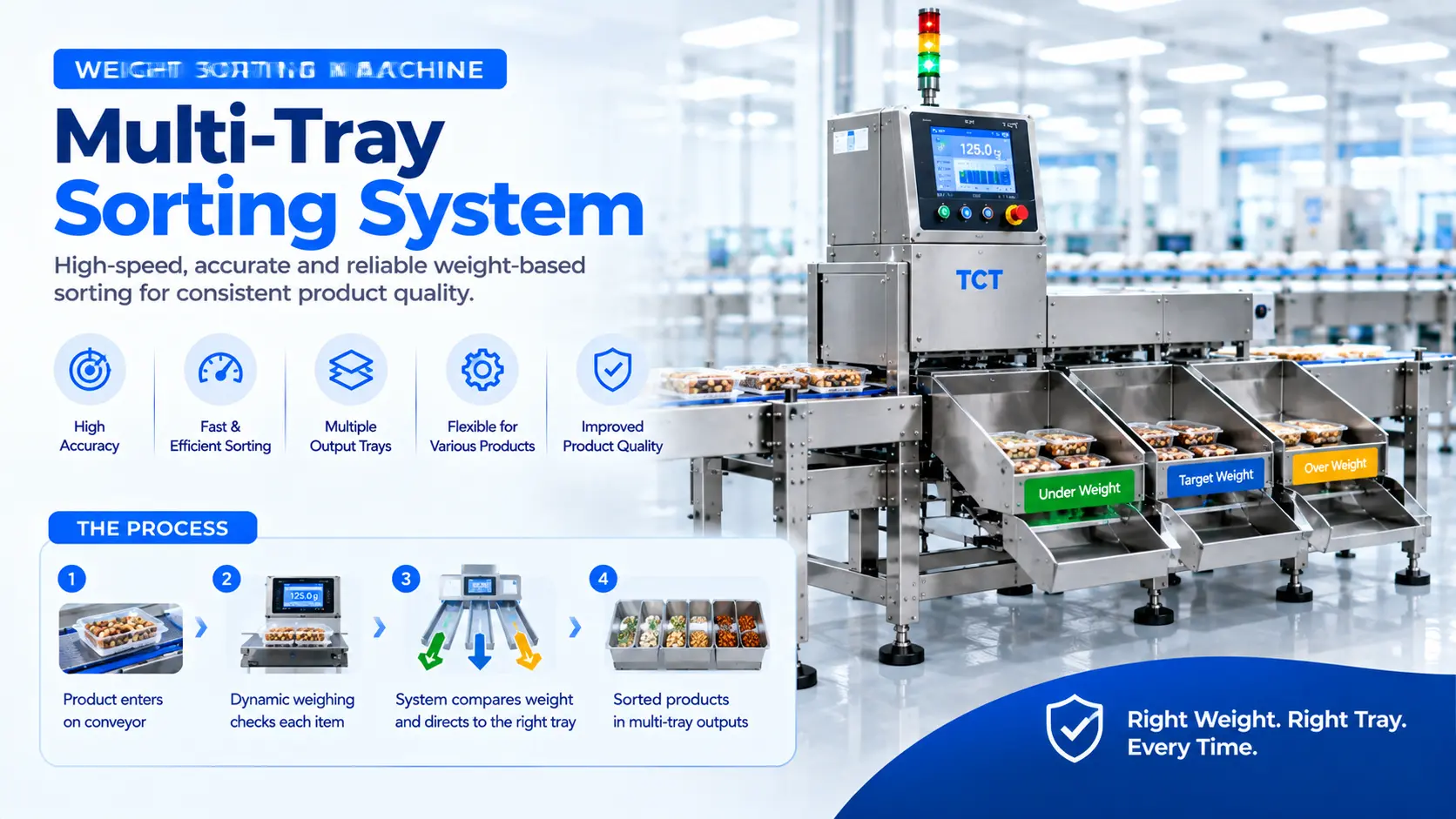
When you sell shrimp by count, chicken portions by size or fish fillets by weight band, the value of each piece depends on its weight class. A weight sorting machine weighs every piece individually and sends it to the right grade, faster and more consistently than a sorting table of workers with hand scales. This guide explains how multi-tray sorters work, how to set grade bands, what hygiene requires, and how to judge the return on investment.
What weight grading is
Weight grading divides a stream of individual items into classes, or grades, defined by weight bands. Each grade is then packed, priced or processed separately.
It matters commercially for three reasons:
What weight grading is
Weight grading divides a stream of individual items into classes, or grades, defined by weight bands. Each grade is then packed, priced or processed separately.
It matters commercially for three reasons:
- Buyers pay by grade. Seafood is commonly traded by count (pieces per kg or per pound), and larger counts command different prices. Poultry portions, fish fillets and many fresh products are specified by weight band in customer contracts.
- Uniform packs. A tray of fillets that all fall within a narrow band looks better, cooks evenly and makes fixed-weight packs easier to fill without giveaway.
- Downstream efficiency. Uniform pieces process more consistently through marinating, freezing, breading or cooking.
The stakes are high for Indian exporters. According to MPEDA, India exported seafood worth US$7.45 billion in FY 2024-25, with frozen shrimp the top item by both quantity and value at an estimated 741,529 tonnes. Count grading sits at the heart of that trade, so a few percent of mis-graded product carries a real price.
How a multi-tray sorter works
A multi-tray weight sorter has three stages: singulation, weighing and discharge.
How a multi-tray sorter works
A multi-tray weight sorter has three stages: singulation, weighing and discharge.
- Infeed and singulation. Items arrive one at a time, either loaded by hand onto individual trays or carried singly on a belt. Each item must be weighed alone.
- Dynamic weighing. Each item crosses a weigh cell in motion. The controller records its weight and assigns it to a grade according to the bands you have set.
- Tracking and discharge. The system tracks each item along the sorting line. When it reaches the station for its grade, a tray tilts, a flap opens or a pusher acts, dropping the item into that grade's bin or onto a take-away conveyor. Items outside all bands go to a reject or rework station.
Applications
TCT's product page lists the TCW-MTS for seafood, poultry, aquatic products and frozen goods.
Weight grading is also widely used for fresh produce such as fruit. If you want to grade fruit or vegetables on a TCT sorter, ask us to confirm suitability for your product and run a trial first.
Setting grade bands
Grade bands should come from your customers' specifications, not from the machine.
Start with these steps:
- List the grades your buyers pay for. For shrimp this may be count ranges; for poultry, portion weights such as 150–180 g and 180–210 g.
- Convert counts to piece weights. A count of 21/25 per pound, for example, means pieces of roughly 18–22 g. Make the conversion explicit so everyone uses the same numbers.
- Allow for machine accuracy at the band edges. A piece weighing almost exactly the band limit can fall either side. If accuracy is ±0.5 g, pieces within 0.5 g of a boundary are uncertain. Decide which way you would rather err, usually towards the lower-value grade, to protect customer claims.
- Check the distribution. Run a sample and look at the histogram. If 40% of pieces land in one grade and that grade has one bin, that station will be your bottleneck.
- Plan for glaze and moisture. For frozen seafood, decide whether you are grading before or after glazing, because glaze adds weight. Specify bands accordingly.
- Review regularly. Raw material changes with season and source. Re-check the distribution when it does.
Hygiene and washdown
Sorters for seafood and poultry work in wet, cold, high-risk areas. Cleanability is as important as accuracy.
Ingress protection. The TCW-MTS is published at IP66, meaning it is dust-tight and protected against powerful water jets. Confirm your sanitation method (pressure, temperature, chemicals) with the supplier.
Materials. Food-contact parts should be stainless steel or food-grade plastic. TCT uses SS 304 with food-grade resin.
Tool-free disassembly. Trays, belts and guides should come off without tools for daily cleaning. TCT describes a buckle design for this.
No harbourage points. Look for open frames, sloped surfaces and few hollow sections where water and debris collect.
Weighing stability after washdown. Water on the weigh cell or trays affects readings. Build a drain-and-zero step into your start-up SOP.
HACCP fit. The sorter is part of your process flow; include it in hazard analysis and cleaning verification such as swab testing.
Return on investment
The payback from a weight sorter comes from a few measurable sources. Use your own numbers in this simple model.
- Recovered value from correct grading. Manual grading tends to drift towards lower grades to stay safe. If a sorter moves even a small share of product into the correct higher-value grade, the price difference across your annual tonnage adds up quickly.
- Reduced giveaway in fixed-weight packs. Uniform pieces let you fill fixed-weight packs closer to the declared weight
- Labour. A sorter replaces repetitive hand weighing. Staff can move to trimming, inspection or packing.
- Fewer claims. Consistent grading means fewer buyer complaints and rejected lots.
Illustrative example (replace with your figures): a plant grades 2 tonnes of shrimp a day. If better grading moves 2% of that volume into a grade worth ₹50 more per kg, recovered value is 40 kg × ₹50 = ₹2,000 a day, or roughly ₹6 lakh over 300 working days, before labour savings. At 60 pieces a minute, check that the sorter's throughput matches your daily volume for the piece size you run.
For how sorters relate to other weighing equipment, see our Check Weigher Buying Guide.
Request a free line assessment or product trial.
Frequently asked questions
What is the difference between a check weigher and a weight sorter? A check weigher accepts or rejects packs against one target. A weight sorter assigns each item to one of several grades.
How fast is TCT's multi-tray sorter? It is published at up to 60 pieces per minute, with a weight range of 5–3,000 g.
Can it be washed down? It is published at IP66 with SS 304 and food-grade resin construction. Confirm your cleaning regime with TCT.