
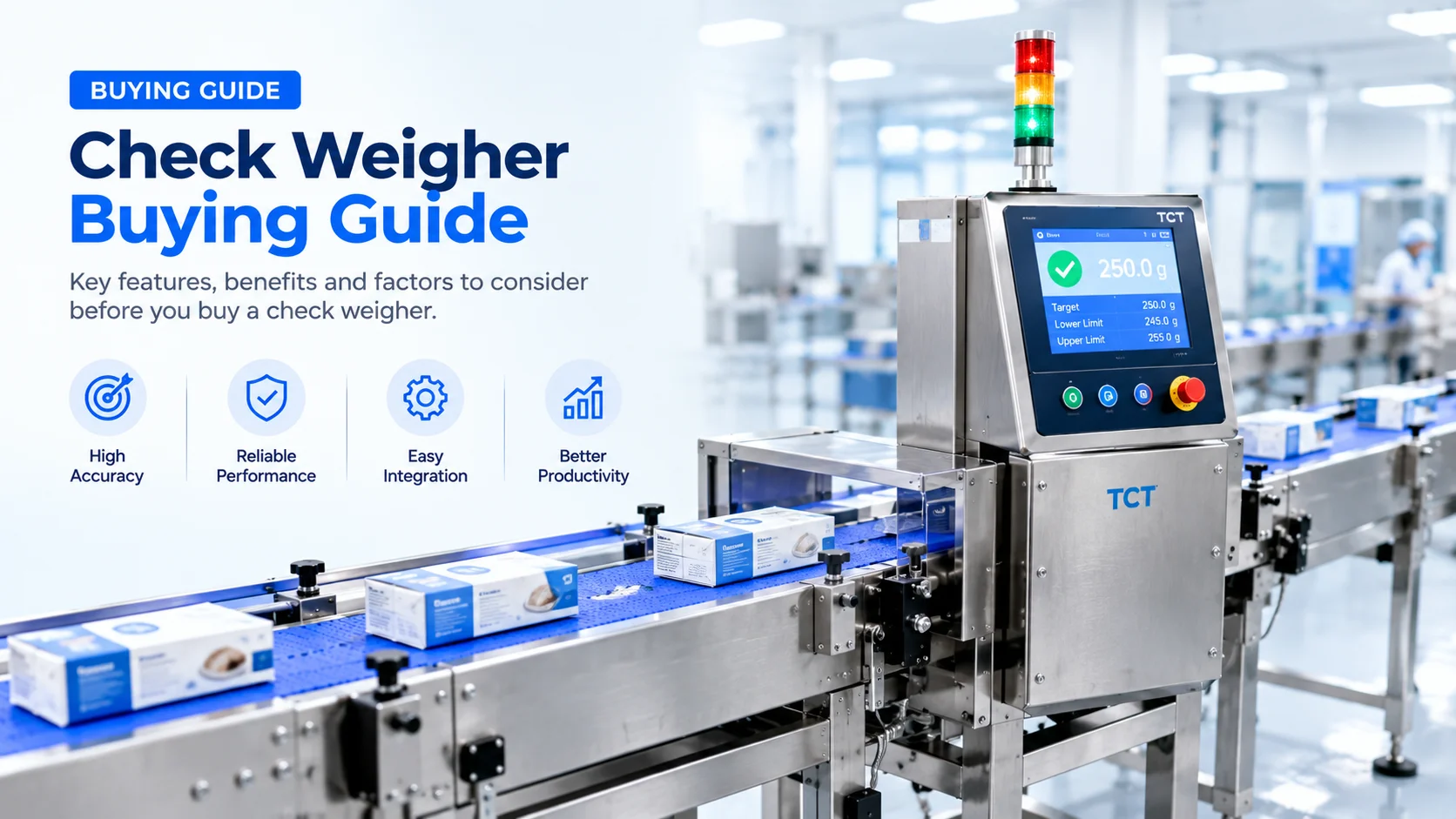
A check weigher pays for itself only when it matches the product, the line speed and the accuracy your regulator or customer expects. This check weigher selection guide walks through those three decisions in order, then maps each True Care Technology (TCT) model to the job it does best. If you are comparing quotes right now, use the checklist at the end before you sign a purchase order.
Start with your product
Every selection begins with the pack, not the machine. Write down four facts before you speak to any supplier: the lightest and heaviest pack you will run, the pack dimensions, the pack format and how stable it is on a belt.
Weight range. A check weigher's load cell is sized for a range. A machine built for 1–300 g packs will not give useful readings on a 5 kg carton, and a 25 kg carton scale will not resolve a 10 g sachet. If you run several SKUs, size for the full span and check the resolution (division) at the light end.
Dimensions. The weigh belt must carry the whole pack, with a gap before the next one arrives. TCT's standard online check weigher accepts packs up to about 100 mm × 100 mm, the large-package model handles up to 550 mm × 450 mm, and the long-product model takes packs up to 1,500 mm long.
Pack format. Pouches, cartons, bottles, jars, blister cartons and long flow-wraps all behave differently. Tall, narrow bottles can topple at transfer; pillow packs can slide; long packs can bridge two belts. The format decides the conveyor type, the guide rails and the reject device.
Stability and surface. Note anything that moves inside the pack (liquids, loose granules) and anything that sticks or sheds dust. Both affect settling time on the weigh belt and therefore the achievable speed.
Line speed and throughput
Throughput is the number of packs per minute the check weigher must handle at your peak line rate, not the average. Add 10–20% headroom so the weigher never becomes the bottleneck after a filler upgrade.
Speed and accuracy pull against each other. The faster a pack crosses the weigh belt, the less time the load cell has to settle, and the more vibration and air movement matter. That is why high-speed models use short weigh belts, fast-response electronics and windshields.
To check whether a model can keep up, work out the pack pitch: pack length plus the gap you need between packs. Multiply the pitch by packs per minute to get the belt speed required.
Worked example: 120 packs/min × (150 mm pack + 150 mm gap) = 120 × 0.30 m = 36 m/min. TCT's standard online check weigher runs belts at 20–90 m/min, so this line sits comfortably in range. If your infeed cannot create a reliable gap, plan for a spacing belt or an indexing infeed.
Typical published speeds across the TCT range run from about 40 packs/min on heavy cartons to 450 packs/min on the ultra high speed model for small packs. Treat every figure as product-dependent and confirm it in a trial on your own packs.
How much accuracy you need
Accuracy is the decision buyers most often get wrong in both directions. Too little and you either ship short-weight packs or overfill to stay safe; too much and you pay for a balance-grade machine you do not need.
Legal Metrology sets the floor for packaged goods sold in India. Under the First Schedule of the Legal Metrology (Packaged Commodities) Rules, 2011, each declared quantity has a maximum permissible error (MPE) in deficiency. For packs declared by weight, the limits are:
So a 500 g pack may be up to 15 g short as an individual error, but inspectors also test the average of a sample against the declared quantity. A check weigher that can only resolve to the nearest 10 g gives you no useful control on that pack. A common engineering rule of thumb is that the machine's repeatability (expressed as three standard deviations) should be a small fraction of the tolerance band you want to enforce.
Commercial targets are often tighter. Retail customers and export buyers may set their own limits, and your finance team will care about giveaway: every gram over declared weight is product you give away. Tight weighing lets you lower the filler target safely.
Pharma needs are different. For tablets, capsules and small pharma packs, the question is usually missing units, a missing leaflet or a missing blister strip. A balance-grade check weigher makes sense when a missing item weighs only a few grams or less. TCT's balance-grade model resolves to 0.01 g on packs of 1–50 g.
Matching the model to the application
The table below summarises published figures from TCT's product pages. Ranges vary by variant.
If you are not sure whether you need a dynamic check weigher at all, our earlier post Online Check Weigher vs. Static Scale compares the two approaches.
Rejects, integration and data
Reject type. Air-blast rejecters suit light packs; pusher arms suit cartons and bottles; drop-flap or diverter rejecters suit fragile or heavy items. Insist on a lockable reject bin and, for audited lines, reject confirmation so you know every rejected pack actually left the line.
Combined metal detection. If you also need metal detection and floor space is tight, a combined system shares one conveyor, one screen and one reject station. Our post on combo vs separate machines explains when that makes sense.
Upstream feedback. A check weigher that sends a trend signal back to the filler can pull the fill target closer to the declared weight, cutting giveaway.
Reporting and electronic records. At minimum you want batch totals, accept/reject counts, mean and standard deviation per batch, and password-controlled settings. TCT machines provide three-level password protection and on-screen statistics. For pharma lines, electronic records matter more: India's revised Schedule M good manufacturing practice became binding on all drug manufacturers from 1 January 2026, with the CDSCO directing state regulators to begin inspections. If you export to the US, records may also fall under FDA 21 CFR Part 11. Ask suppliers exactly which audit-trail and e-signature functions their software provides.
Request a free line assessment or product trial.
Frequently asked questions
How accurate does a check weigher need to be? Accurate enough that its repeatability is small compared with your tolerance band. For Indian retail packs, start from the Legal Metrology MPE for your declared quantity, then tighten to your commercial target.
Can one check weigher handle all my SKUs? Often, if all packs sit within one weight range and size limit. Very light and very heavy packs on the same line usually need two machines.
What drives check weigher price? Weight range, accuracy grade, speed, conveyor size, reject type, combined metal detection and the data/software package.
Start with your product
Every selection begins with the pack, not the machine. Write down four facts before you speak to any supplier: the lightest and heaviest pack you will run, the pack dimensions, the pack format and how stable it is on a belt.
Weight range. A check weigher's load cell is sized for a range. A machine built for 1–300 g packs will not give useful readings on a 5 kg carton, and a 25 kg carton scale will not resolve a 10 g sachet. If you run several SKUs, size for the full span and check the resolution (division) at the light end.
Dimensions. The weigh belt must carry the whole pack, with a gap before the next one arrives. TCT's standard online check weigher accepts packs up to about 100 mm × 100 mm, the large-package model handles up to 550 mm × 450 mm, and the long-product model takes packs up to 1,500 mm long.
Pack format. Pouches, cartons, bottles, jars, blister cartons and long flow-wraps all behave differently. Tall, narrow bottles can topple at transfer; pillow packs can slide; long packs can bridge two belts. The format decides the conveyor type, the guide rails and the reject device.
Stability and surface. Note anything that moves inside the pack (liquids, loose granules) and anything that sticks or sheds dust. Both affect settling time on the weigh belt and therefore the achievable speed.
Line speed and throughput
Throughput is the number of packs per minute the check weigher must handle at your peak line rate, not the average. Add 10–20% headroom so the weigher never becomes the bottleneck after a filler upgrade.
Speed and accuracy pull against each other. The faster a pack crosses the weigh belt, the less time the load cell has to settle, and the more vibration and air movement matter. That is why high-speed models use short weigh belts, fast-response electronics and windshields.
To check whether a model can keep up, work out the pack pitch: pack length plus the gap you need between packs. Multiply the pitch by packs per minute to get the belt speed required.
Worked example: 120 packs/min × (150 mm pack + 150 mm gap) = 120 × 0.30 m = 36 m/min. TCT's standard online check weigher runs belts at 20–90 m/min, so this line sits comfortably in range. If your infeed cannot create a reliable gap, plan for a spacing belt or an indexing infeed.
Typical published speeds across the TCT range run from about 40 packs/min on heavy cartons to 450 packs/min on the ultra high speed model for small packs. Treat every figure as product-dependent and confirm it in a trial on your own packs.
How much accuracy you need
Accuracy is the decision buyers most often get wrong in both directions. Too little and you either ship short-weight packs or overfill to stay safe; too much and you pay for a balance-grade machine you do not need.
Legal Metrology sets the floor for packaged goods sold in India. Under the First Schedule of the Legal Metrology (Packaged Commodities) Rules, 2011, each declared quantity has a maximum permissible error (MPE) in deficiency. For packs declared by weight, the limits are:
So a 500 g pack may be up to 15 g short as an individual error, but inspectors also test the average of a sample against the declared quantity. A check weigher that can only resolve to the nearest 10 g gives you no useful control on that pack. A common engineering rule of thumb is that the machine's repeatability (expressed as three standard deviations) should be a small fraction of the tolerance band you want to enforce.
Commercial targets are often tighter. Retail customers and export buyers may set their own limits, and your finance team will care about giveaway: every gram over declared weight is product you give away. Tight weighing lets you lower the filler target safely.
Pharma needs are different. For tablets, capsules and small pharma packs, the question is usually missing units, a missing leaflet or a missing blister strip. A balance-grade check weigher makes sense when a missing item weighs only a few grams or less. TCT's balance-grade model resolves to 0.01 g on packs of 1–50 g.
Matching the model to the application
The table below summarises published figures from TCT's product pages. Ranges vary by variant.
If you are not sure whether you need a dynamic check weigher at all, our earlier post Online Check Weigher vs. Static Scale compares the two approaches.
Rejects, integration and data
Reject type. Air-blast rejecters suit light packs; pusher arms suit cartons and bottles; drop-flap or diverter rejecters suit fragile or heavy items. Insist on a lockable reject bin and, for audited lines, reject confirmation so you know every rejected pack actually left the line.
Combined metal detection. If you also need metal detection and floor space is tight, a combined system shares one conveyor, one screen and one reject station. Our post on combo vs separate machines explains when that makes sense.
Upstream feedback. A check weigher that sends a trend signal back to the filler can pull the fill target closer to the declared weight, cutting giveaway.
Reporting and electronic records. At minimum you want batch totals, accept/reject counts, mean and standard deviation per batch, and password-controlled settings. TCT machines provide three-level password protection and on-screen statistics. For pharma lines, electronic records matter more: India's revised Schedule M good manufacturing practice became binding on all drug manufacturers from 1 January 2026, with the CDSCO directing state regulators to begin inspections. If you export to the US, records may also fall under FDA 21 CFR Part 11. Ask suppliers exactly which audit-trail and e-signature functions their software provides.
Request a free line assessment or product trial.
Frequently asked questions
How accurate does a check weigher need to be? Accurate enough that its repeatability is small compared with your tolerance band. For Indian retail packs, start from the Legal Metrology MPE for your declared quantity, then tighten to your commercial target.
Can one check weigher handle all my SKUs? Often, if all packs sit within one weight range and size limit. Very light and very heavy packs on the same line usually need two machines.
What drives check weigher price? Weight range, accuracy grade, speed, conveyor size, reject type, combined metal detection and the data/software package.