
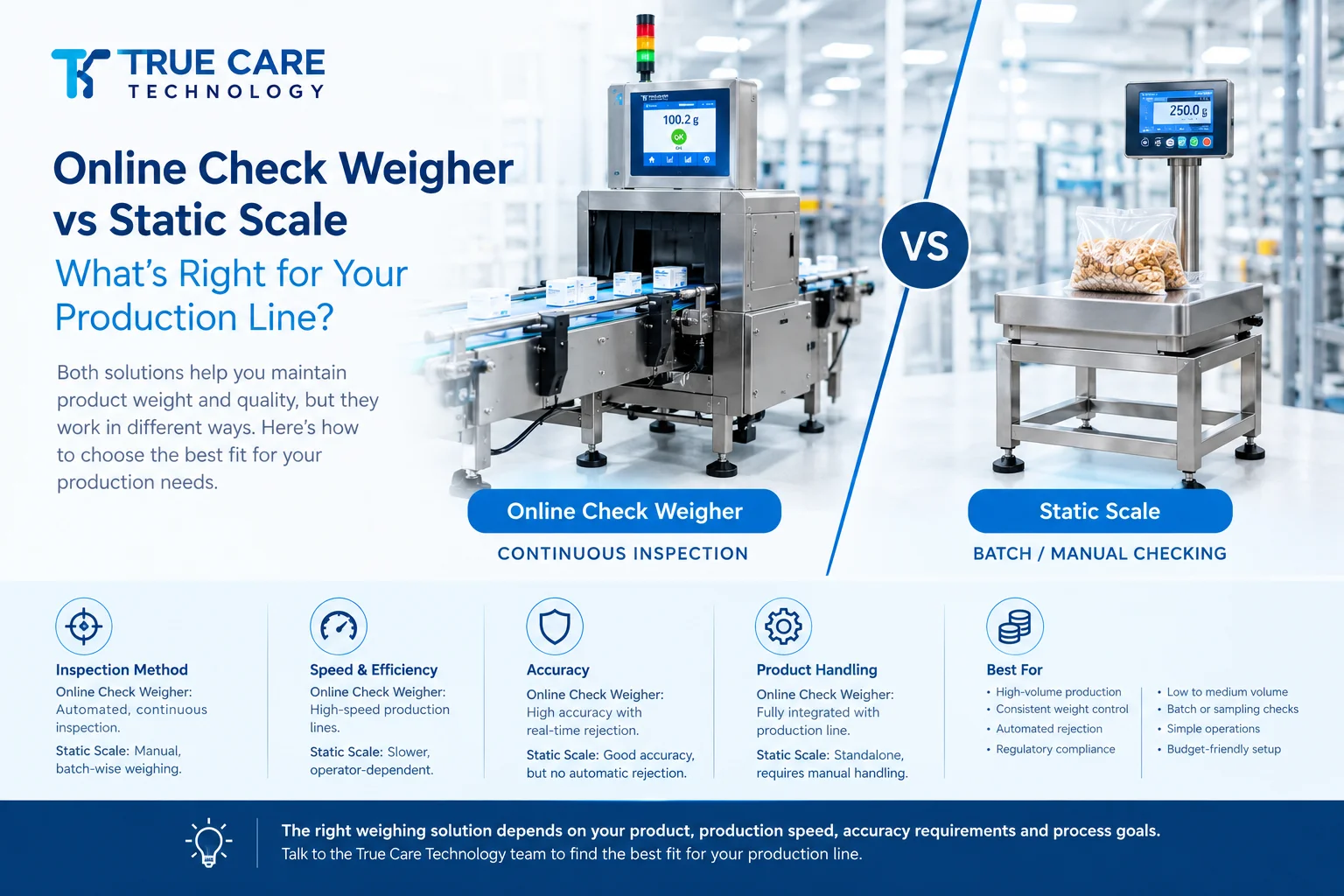
Both online check weighers and static scales help manufacturers control product weight. The difference is how they measure, where they fit into the production process, and how much automation they provide.
Accurate weighing is an important part of manufacturing quality control. Whether you are producing packaged foods, pharmaceuticals, beverages, cosmetics, chemicals or other consumer products, maintaining consistent product weight can help reduce giveaway, identify underweight products and maintain production standards.
But choosing the right weighing solution is not always straightforward.
Should you use a static scale where operators weigh products individually?
Or should you integrate an online check weigher directly into your production line?
The answer depends on your production volume, product characteristics, required weighing accuracy, available labour, line speed and level of automation.
What Is an Online Check Weigher?
An online check weigher is an automated weighing system installed directly into a production or packaging line.
Products move across the weighing conveyor while the system measures each individual product without requiring an operator to manually place it on a scale.
A typical process is:
Product Infeed → Weighing → Weight Evaluation → Pass/Fail Decision → Automatic Rejection
If a product falls outside the configured weight limits, the system can activate an automatic rejection mechanism to remove the product from the production stream.
This makes online check weighers particularly useful for continuous, high-speed production environments.
True Care Technology provides check-weighing solutions designed for applications including food, pharmaceutical, beverage, dairy and other production environments. (truecaretech.com)
What Is a Static Scale?
A static scale is a weighing system in which the product remains stationary while its weight is measured.
In a typical production environment, an operator may:
Pick up the product.
Pick up the product.
- Place it on the weighing platform.
- Wait for the measurement.
- Record or evaluate the weight.
- Remove the product.
- Repeat the process.
Static scales can be useful when production volumes are relatively low, products are handled in batches, or individual manual weighing is appropriate for the application.
They can also be useful for quality-control sampling, laboratory environments and production processes where continuous automated inspection is not required.
When Should You Choose an Online Check Weigher?
An online check weigher may be appropriate when you need:
High production throughput
Products are continuously moving through an automated production or packaging line.
100% product weighing
Every product needs to be individually checked rather than relying only on periodic sampling.
Automatic rejection
Underweight or overweight products need to be automatically removed.
Underweight or overweight products need to be automatically removed.
Reduced manual handling
You want to minimize repetitive weighing operations performed by production staff.
Production data
You need real-time weight information and production statistics.
Process integration
The weighing system needs to communicate or operate alongside other production equipment.
When Is a Static Scale More Appropriate?
A static scale may be suitable when:
Production volume is relatively low
The number of products requiring weighing does not justify automated in-line equipment.
Products are produced in batches
The process naturally involves batch-based weighing and quality checks.
Sampling is sufficient
The quality-control procedure requires periodic product-weight checks rather than 100% inspection.
Products are difficult to convey
Large, irregular or unstable products may be easier to weigh while stationary.
Flexibility is more important than automation
Operators need to weigh different products or materials individually using a common weighing station.
Budget and simplicity are priorities
A standalone weighing station may require less equipment and integration than an automated production-line system.