
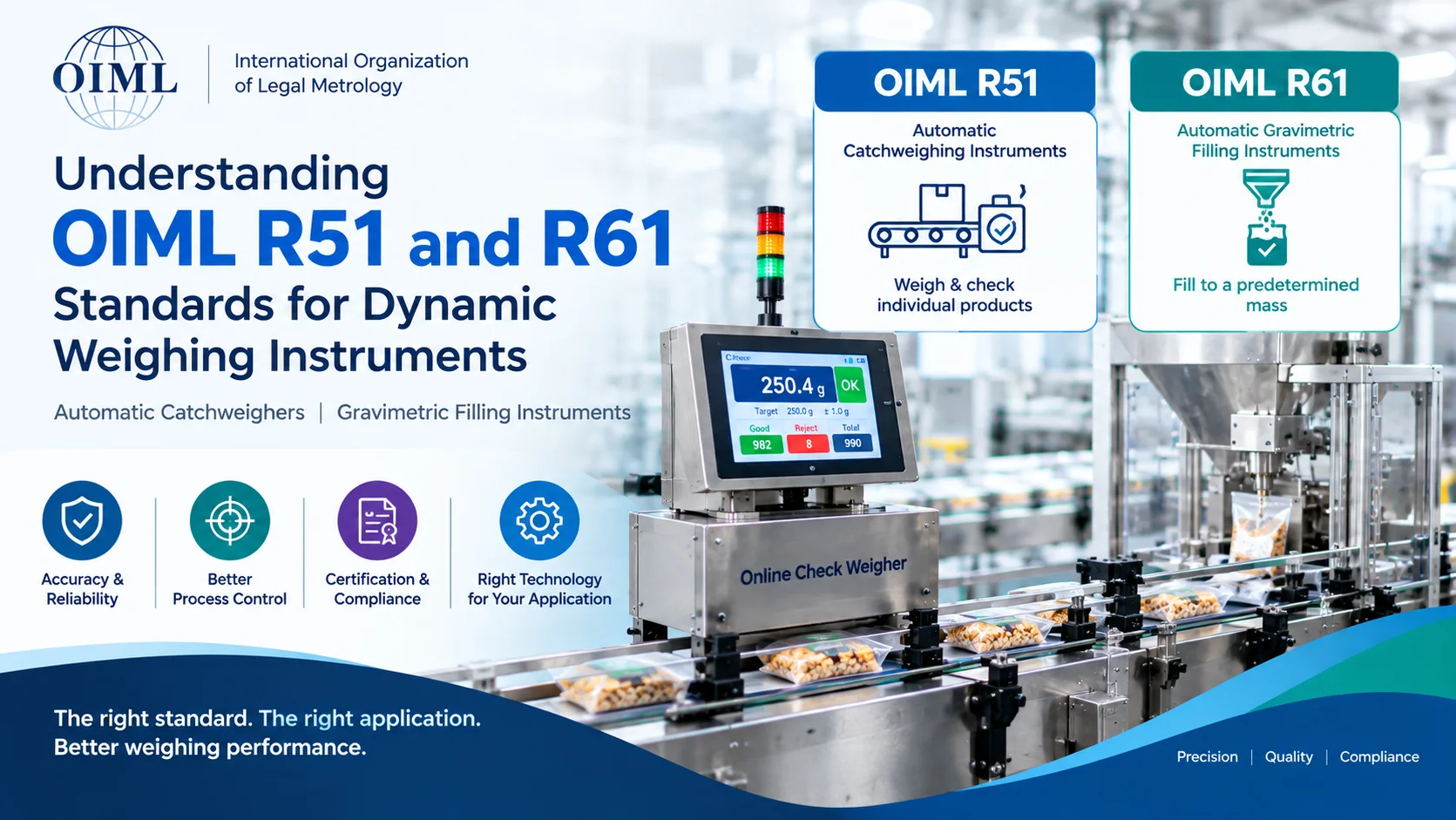
A Practical Guide to Automatic Catchweighers and Gravimetric Filling Instruments
Accurate weighing is an important part of modern manufacturing.
In food, pharmaceutical, nutraceutical, chemical and FMCG production, weighing systems are used to control product quantity, reduce giveaway, identify underweight or overweight products and maintain consistent production quality.
When weighing takes place automatically while products are moving through a production process, manufacturers may encounter OIML R 51 and OIML R 61.
These two OIML Recommendations address different categories of automatic weighing instruments:
- OIML R 51 — Automatic catchweighing instruments
- OIML R 61 — Automatic gravimetric filling instruments
Understanding the difference is important when specifying an automated weighing system, evaluating equipment documentation or discussing metrological requirements with suppliers.
OIML lists both R 51 and R 61 among the measuring-instrument categories covered by the OIML Certification System (OIML-CS).
What Is OIML?
The International Organization of Legal Metrology (OIML) develops international Recommendations, Documents and other guidance for legal metrology.
OIML Recommendations provide internationally developed technical and metrological requirements for particular types of measuring instruments.
However, an important distinction should be made:
An OIML Recommendation is not automatically the same thing as a legal requirement in every country.
Whether an instrument must meet a particular OIML Recommendation, obtain a particular approval or undergo local verification depends on the applicable national or regional legal-metrology framework.
Therefore, manufacturers should consider both:
- The relevant OIML Recommendation.
- The legal requirements applicable in the market where the instrument will be used.
OIML R 51: Automatic Catchweighing Instruments
OIML R 51 applies to automatic catchweighing instruments, commonly referred to as catchweighers or automatic checkweighers.
The OIML R 51 scope covers instruments that automatically weigh discrete loads or individual loads of loose material.
This makes R 51 particularly relevant to applications where individual products are weighed automatically while moving through a production process.
Typical examples include:
- Packaged food
- Pharmaceutical products
- Bottles
- Cartons
- Pouches
- Boxes
- Bags
- Individual manufactured products
- Other discrete products
An automated check weigher can determine whether a product falls within the configured weight range and, depending on the application, automatically reject products that do not meet the specified criteria.
OIML R 51 Accuracy Categories
One of the important concepts in R 51 is the classification of automatic catchweighing instruments.
For Category X instruments, R 51 defines accuracy classes:
- XI
- XII
- XIII
- XIIII
The appropriate class depends on the intended application and applicable requirements. R 51 also uses an x-factor associated with the instrument's accuracy class and specified by the manufacturer.
The OIML document also distinguishes Category X instruments used for checking prepacked products subject to OIML R 87 from Category Y instruments used for other automatic catchweighing applications.
This distinction is important because manufacturers should not simply ask:
"Is the machine OIML R 51?"
They should also determine:
- Which category applies?
- Which accuracy class applies?
- What is the specified x-factor?
- What product and operating conditions were evaluated?
- What national metrological requirements apply?
What Is an Online Check Weigher?
An online check weigher continuously weighs products as they travel through a production or packaging line.
A typical process is:
Product Infeed → Product Separation → Dynamic Weighing → Weight Evaluation → Automatic Rejection → Accepted Product
The machine measures the product while it is moving rather than requiring an operator to manually place each product on a static scale.
This makes dynamic check weighing particularly useful for high-throughput manufacturing.
True Care Technology offers online check-weighing systems for applications across industries including food, pharmaceutical, nutraceutical, chemical and FMCG manufacturing. Its portfolio includes standard, high-speed, heavy-duty, large-package, revolving and tablet/capsule check-weighing systems.
OIML R 61: Automatic Gravimetric Filling Instruments
OIML R 61 addresses a different type of weighing application.
R 61 applies to automatic gravimetric filling instruments (AGFIs).
The 2017 edition specifies metrological and technical requirements, metrological controls and tests for instruments that produce predetermined-mass individual fills of products by automatic weighing.
In simple terms:
R 51 → Automatically checks the weight of discrete products or loads
R 61 → Automatically creates a predetermined-mass fill
R 61 → Automatically creates a predetermined-mass fill
This distinction is important when selecting equipment.