From 1 January 2026, every pharmaceutical manufacturing unit in India is expected to conform to the revised Schedule M good manufacturing practices, after the extension for units with turnover below ₹250 crore ended on 31 December 2025 (Business Standard).
Readiness was uneven: only about 1,700 of an estimated 6,500 MSME units without WHO-GMP certification were reported to have filed upgrade plans, with upgrade costs estimated at ₹50 lakh to ₹2.5 crore (Vision IAS, summarising Business Standard).
For many of these plants, one of the most visible gaps is open powder handling: operators scooping APIs and excipients from drums into blenders, with dust in the air and on every surface. A vacuum conveying system is one of the most practical ways to close that gap. This guide explains how it works and why it matters for GMP.
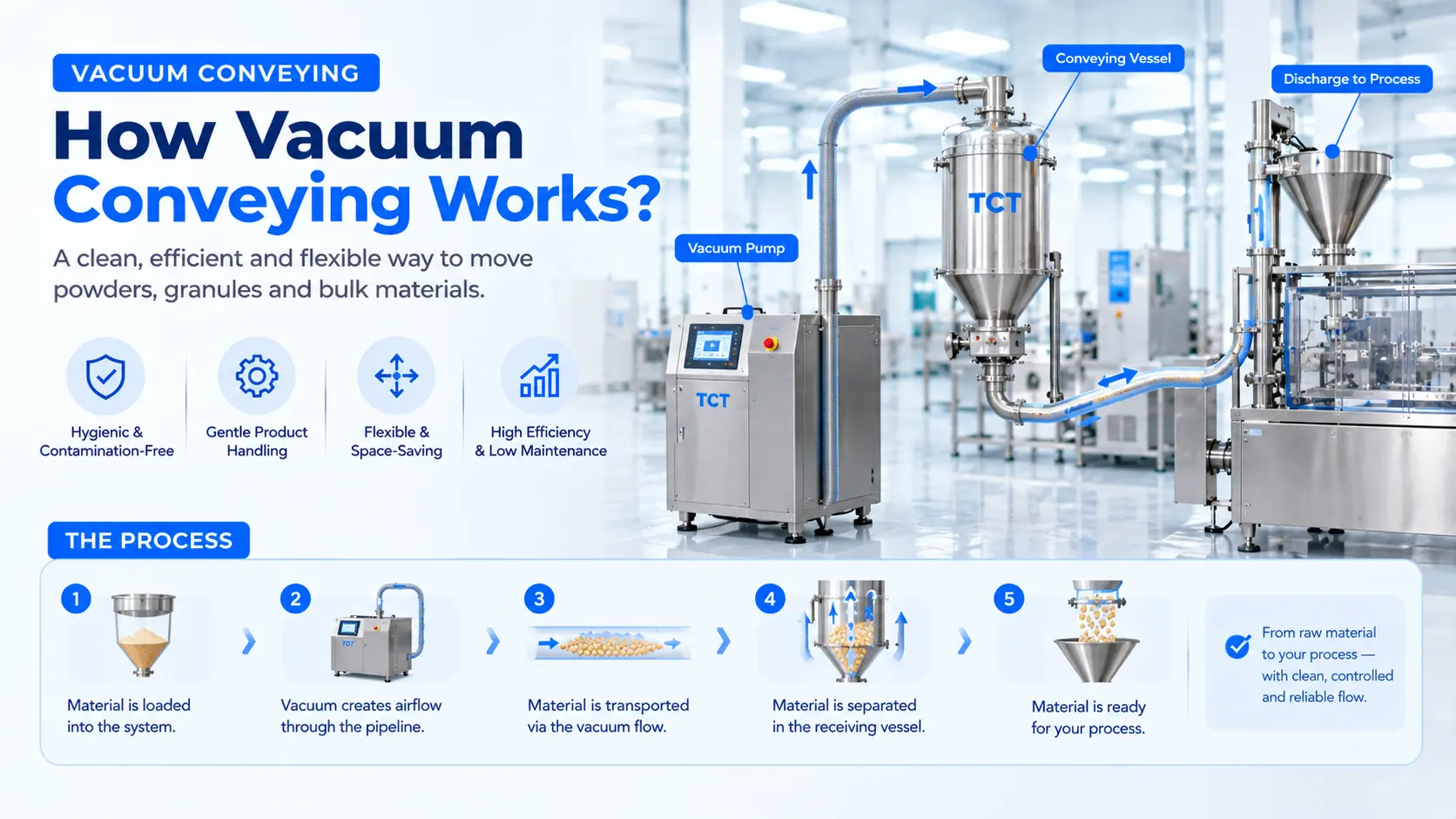
How vacuum conveying works
A vacuum conveying system moves dry powders and granules through a sealed pipe, using negative pressure instead of buckets, scoops or mechanical conveyors.
The cycle runs in four steps:
- Suction: a vacuum pump creates negative pressure in a receiver vessel mounted above the destination equipment.
- Conveying: air rushes in at the pick-up point (a drum lance, bag-tipping station or hopper) and carries the powder through the pipe into the receiver.
- Separation: a filter in the receiver stops the powder from reaching the pump. Material collects in the receiver.
- Discharge: the vacuum stops, the discharge valve opens and the powder drops into the blender, press or hopper below. At the same time, a pulse of air blows back through the filter to clean it.
The cycle then repeats automatically, controlled by timers or level sensors.
TCT's Powder Vacuum Transfer System works on this principle, operating at up to –0.6 bar with a vacuum pump or compressed-air ejector. It conveys 50–2,000 kg/h over distances up to 15 m (combined vertical and horizontal), depending on the material.
Benefits of closed transfer
Because the powder never leaves the pipe and receiver, a closed transfer system tackles the two biggest powder-handling risks in a GMP area.
Negative pressure also gives a built-in safety margin. If a joint leaks, air leaks in, not out, so powder does not escape into the room.
Main components
[Insert component diagram: pick-up point → conveying line → receiver with filter → discharge valve → destination equipment, with vacuum pump and control panel.]
Cleaning and changeover
In a multi-product GMP plant, how fast and how well a system can be cleaned often matters as much as how it conveys.
Good design practice includes:
- Smooth, polished contact surfaces: TCT offers ≤0.8 μm Ra finish on contact parts as an option.
- Tool-free connections: tri-clamp fittings allow quick dismantling of the receiver and pipework.
- No dead zones: total discharge with no retention means less product left behind to clean out.
- Suitable filters: PTFE filters release powder easily; antistatic media suit fine or charged powders.
- CIP option: clean-in-place is available as an option for plants that need validated wet cleaning.
- Dedicated filters per product where cross-contamination risk is high.
Document each cleaning step, and validate it with swab or rinse tests as your GMP procedures require.
Operator safety
Manual powder handling is hard on people. Lifting 25 kg bags to blender height, scooping from drums and breathing fine dust are all daily risks in many plants.
A vacuum conveying system reduces:
Operator safety
Manual powder handling is hard on people. Lifting 25 kg bags to blender height, scooping from drums and breathing fine dust are all daily risks in many plants.
A vacuum conveying system reduces:
- Lifting and awkward postures, because powder is drawn up from floor level.
- Dust exposure, which matters especially for potent APIs.
- Slips and spills around equipment.
- Noise: TCT's system is rated at ≤75 dB.
Where fine, combustible dusts are handled, check whether the plant's hazardous-area classification requires additional explosion-protection measures.
Applications
TCT's vacuum transfer system is used across pharmaceutical, nutraceutical, food and chemical plants to:
Applications
TCT's vacuum transfer system is used across pharmaceutical, nutraceutical, food and chemical plants to:
- Transfer powders and granules from bags, drums, bins, IBCs or silos.
- Feed mixers, blenders, granulators, reactors and hoppers.
- Load tablet presses, capsule fillers, coating pans and packaging lines.
- Refill loss-in-weight feeders on continuous lines.
- Replace manual handling in controlled production areas.
It handles materials with bulk densities up to about 1.0 g/cc and runs in batch or continuous mode. Product-contact parts are AISI 316 stainless steel and non-contact parts AISI 304, in a cGMP-compliant design.
Frequently asked questions
How does a vacuum conveying system work? A pump creates negative pressure in a receiver, which pulls powder through a sealed pipe. A filter holds the powder back, and it is discharged in batches into the equipment below.
Why is vacuum conveying good for GMP? It keeps powder inside a closed system, reducing dust, cross-contamination and manual handling.
How far can powder be conveyed? TCT's system conveys up to 15 m, combined vertical and horizontal, depending on the material.
What capacity can a vacuum conveyor reach? TCT's system handles 50–2,000 kg/h, depending on material and distance.
How is the filter kept clean? An automatic pulse-jet or reverse-air blow-back cleans the filter during each discharge.
Make powder transfer clean and safe
Talk to a TCT application engineer about which technology fits your product.
Check: confirm Schedule M status against the current CDSCO position before publishing, and confirm capacity and distance figures for the specific material.