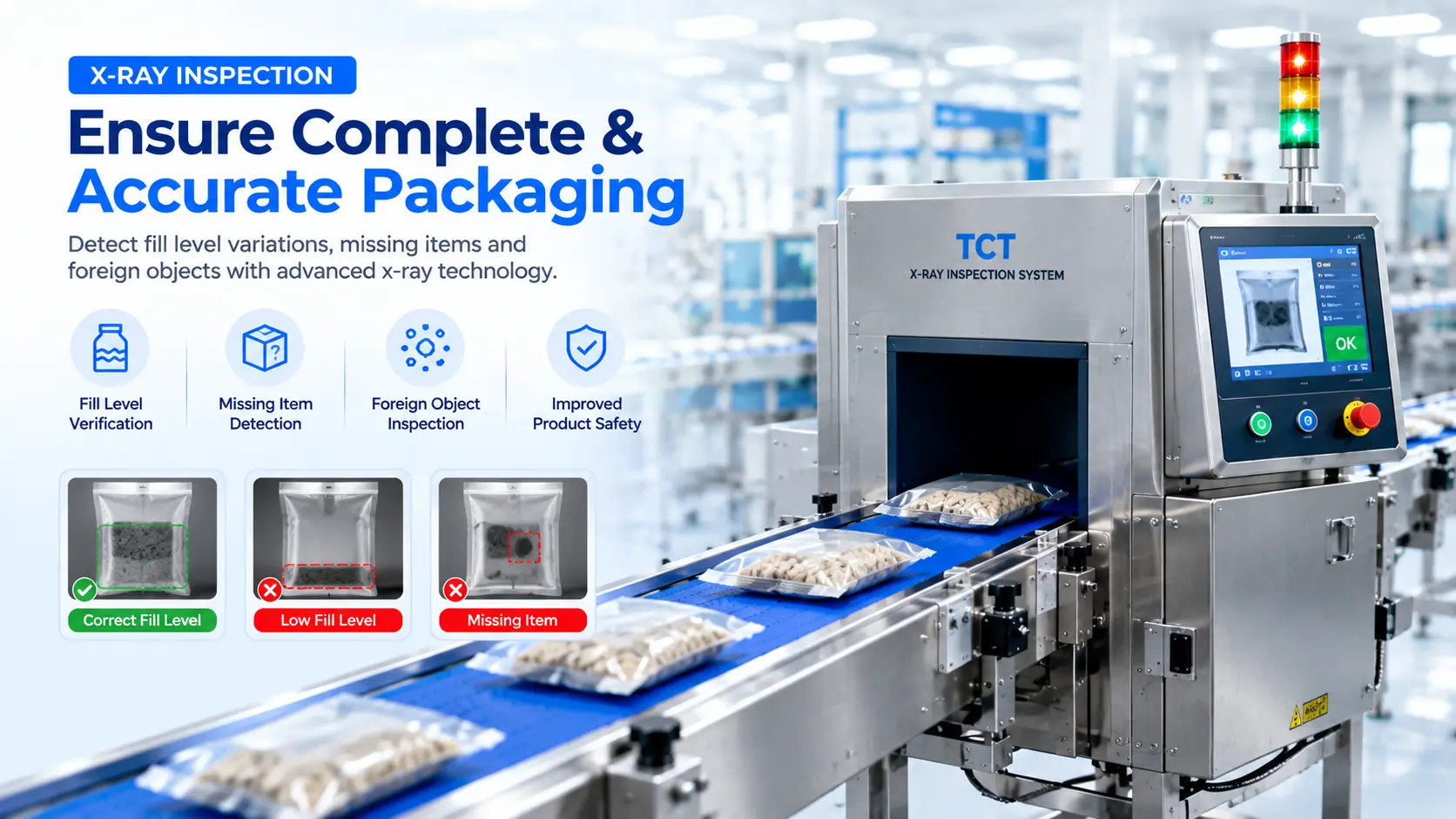
Glass is invisible to a metal detector. That alone is a strong reason to consider X-ray. But X- ray is a bigger investment, and engineers often need to justify it with more than one benefit. The good news: the same X-ray image that finds glass can also check x-ray inspection fill level, count items, spot broken products and, for some packs, check seals. This post explains how.
How X-ray imaging works
An X-ray system sends a low-energy beam through each pack as it passes on a conveyor.A detector on the other side measures how much of the beam gets through.
How X-ray imaging works
An X-ray system sends a low-energy beam through each pack as it passes on a conveyor.A detector on the other side measures how much of the beam gets through.
- Dense materials (metal, glass, bone, stone) absorb more X-rays and appear darker.
- Less dense materials (most food, air gaps, thin film) absorb less and appear lighter.
Software turns these differences into a greyscale image, then analyses it in milliseconds. Because the system measures density, it can do two jobs at once: find things that should not be there, and confirm that what should be there is present and complete.
[Insert sample X-ray images: one with a glass fragment, one showing fill level, one showing
a missing item, one showing product in seal.]
Contaminant detection recap
TCT's Standard X-Ray Inspection System (TXR-S series) detects metal, glass, ceramic, stone, bone, hard rubber and hard plastic. Best-case sensitivity is a 0.3 mm stainless steel ball, 0.2 x 2 mm stainless wire and a 0.8 mm glass or ceramic ball.
Fill level and mass estimation
Because darkness in the image relates to how much material the beam passed through, software can estimate the amount of product in a pack without opening it.
Typical uses:
[Insert sample X-ray images: one with a glass fragment, one showing fill level, one showing
a missing item, one showing product in seal.]
Contaminant detection recap
TCT's Standard X-Ray Inspection System (TXR-S series) detects metal, glass, ceramic, stone, bone, hard rubber and hard plastic. Best-case sensitivity is a 0.3 mm stainless steel ball, 0.2 x 2 mm stainless wire and a 0.8 mm glass or ceramic ball.
Fill level and mass estimation
Because darkness in the image relates to how much material the beam passed through, software can estimate the amount of product in a pack without opening it.
Typical uses:
- Fill level in jars, cans and bottles, even through opaque containers.
- Mass estimation of each pack or each compartment, as a check alongside or in place of a check weigher.
- Under-filled compartments in ready meals or multi-compartment trays that a check weigher cannot see, because the total weight may still look correct.
X-ray mass estimation is not a legal-for-trade replacement for a check weigher. It is best used to find packs that are clearly wrong, or to check individual compartments.
Missing or broken components
The same image can count items and inspect their shape.
Missing or broken components
The same image can count items and inspect their shape.
- Missing items: a box of 12 sachets with only 11, a multipack missing a bar, a blister card with an empty pocket.
- Broken products: snapped biscuits, cracked chocolate bars, broken tablets.
- Displaced products: an item lying in the wrong place or overlapping another.
TCT's TXR systems include defect inspection for breakage, displacement and cracks.
Seal checks
When product gets trapped in a heat seal, the seal can leak, shortening shelf life and risking spoilage. On many flexible packs, X-ray can see product sitting in the seal area because it is denser than the empty film around it.
This works best when:
Seal checks
When product gets trapped in a heat seal, the seal can leak, shortening shelf life and risking spoilage. On many flexible packs, X-ray can see product sitting in the seal area because it is denser than the empty film around it.
This works best when:
- The packaging film is thin and uniform.
- The product is noticeably denser than the film.
- The seal area sits flat as it passes the beam.
It does not replace a leak test, but it can catch a common cause of leaks automatically.
Check: before publishing, list only the checks TCT's X-ray software actually supports. The TXR spec confirms contaminant detection plus breakage, displacement and cracks. Confirm fill level, mass estimation, item counting and seal inspection with TCT engineering.
Replacing several machines with one
The business case for X-ray often comes from consolidation. One X-ray station at the end of a line may take on work that would otherwise need several machines
Add the cost of a recall like the one above (product write-off, logistics, retailer penalties, lost listings and brand damage) and the extra spend on X-ray often becomes easier to defend.
TCT's TXR systems also keep detailed logs of production rates, times and contamination percentages, export data via USB or Ethernet, and operate below 1 μSv/h X-ray emission in line with CE standards.
Frequently asked questions
Can X-ray inspection check fill level? Yes. Fill level and mass can be estimated from how much X-ray energy the product absorbs, even through opaque containers.
Can X-ray find glass in food? Yes. Glass is denser than most foods, so it shows up clearly. TCT's TXR-S system detects glass down to 0.8 mm under best conditions.
Can X-ray replace a check weigher? It can flag clearly under-filled packs, but it is not a legal-for-trade weighing device.
Can X-ray detect missing items in a multipack? Yes. The software can count items in the image and reject packs with missing or broken items.
Is X-ray inspection safe? Yes, when properly designed and shielded. TCT systems emit less than 1 μSv/h in line with CE standards.
See what X-ray can check on your product
Talk to a TCT application engineer about which technology fits your product.
Check: before publishing, list only the checks TCT's X-ray software actually supports. The TXR spec confirms contaminant detection plus breakage, displacement and cracks. Confirm fill level, mass estimation, item counting and seal inspection with TCT engineering.
Replacing several machines with one
The business case for X-ray often comes from consolidation. One X-ray station at the end of a line may take on work that would otherwise need several machines
Add the cost of a recall like the one above (product write-off, logistics, retailer penalties, lost listings and brand damage) and the extra spend on X-ray often becomes easier to defend.
TCT's TXR systems also keep detailed logs of production rates, times and contamination percentages, export data via USB or Ethernet, and operate below 1 μSv/h X-ray emission in line with CE standards.
Frequently asked questions
Can X-ray inspection check fill level? Yes. Fill level and mass can be estimated from how much X-ray energy the product absorbs, even through opaque containers.
Can X-ray find glass in food? Yes. Glass is denser than most foods, so it shows up clearly. TCT's TXR-S system detects glass down to 0.8 mm under best conditions.
Can X-ray replace a check weigher? It can flag clearly under-filled packs, but it is not a legal-for-trade weighing device.
Can X-ray detect missing items in a multipack? Yes. The software can count items in the image and reject packs with missing or broken items.
Is X-ray inspection safe? Yes, when properly designed and shielded. TCT systems emit less than 1 μSv/h in line with CE standards.
See what X-ray can check on your product
Talk to a TCT application engineer about which technology fits your product.