
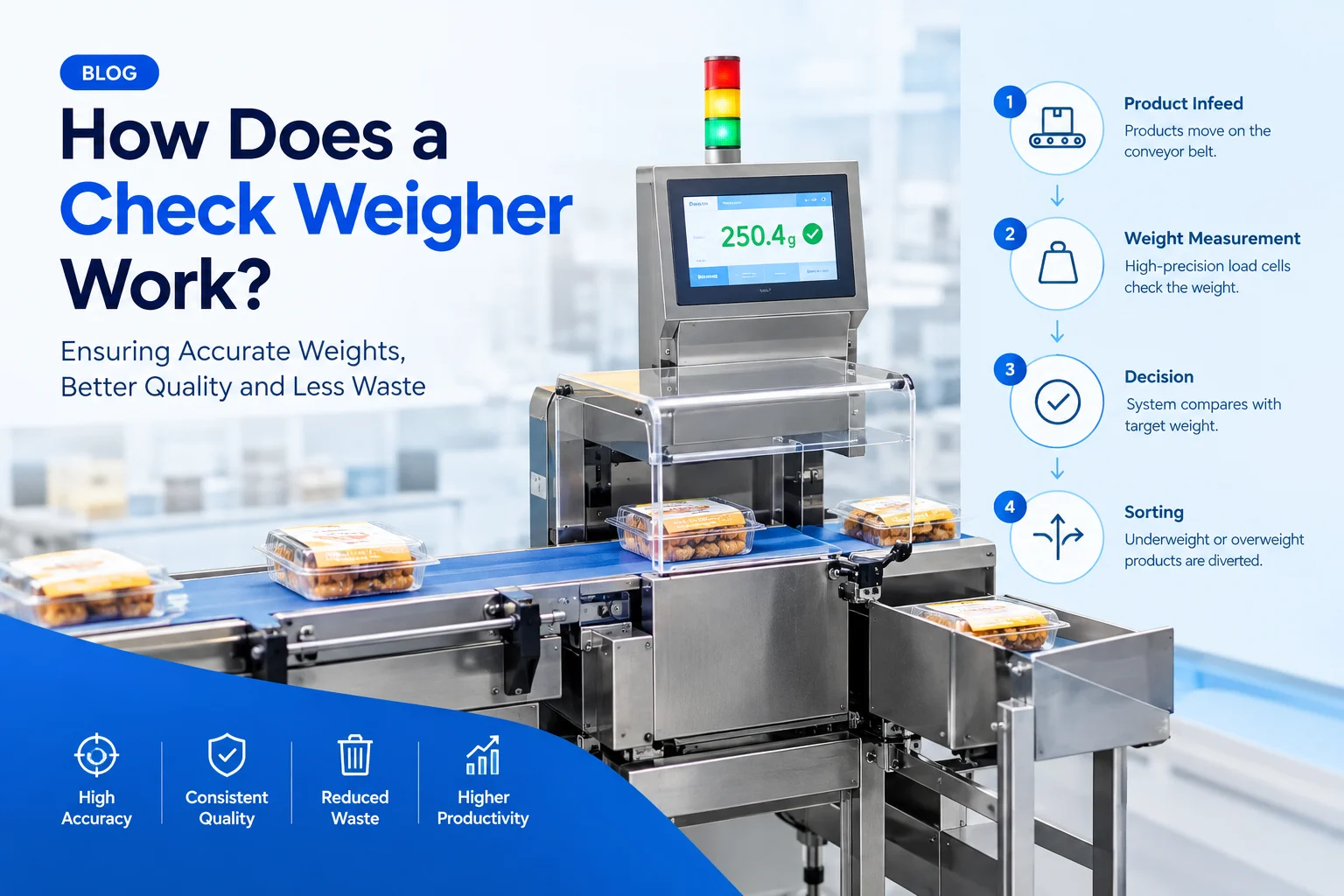
If you have ever wondered how does a check weigher work, the short answer is this: it weighs every single pack while it moves along the conveyor, compares that weight with limits you set, and pushes out any pack that is too light or too heavy. It does this in a fraction of a second, without stopping the line.
Manual sampling checks a few packs every half hour. A dynamic check weigher checks all of them. That difference matters more every year. In India, the Legal Metrology (Packaged Commodities) Rules, 2011 require net quantity to be declared on pre-packaged goods, and the Department of Consumer Affairs keeps updating them: an October 2025 amendment aligned labelling for medical device packs with the Medical Devices Rules, 2017, and a second 2025 amendment takes effect on 1 February 2026. When the declared weight is a legal promise, weighing 100% of packs is the safest way to keep it.
In this guide, TCT's engineers explain the working principle in plain language.
What a check weigher does
A check weigher sorts every pack into one of three classes: underweight, accepted or overweight. Underweight packs break the promise on the label. Overweight packs give product away for free.
Unlike a static scale, the check weigher never asks the operator to stop and place a pack. Weighing happens dynamically, as part of the flow. The result is a full record of every pack, not a statistical guess from a sample.
The infeed, weigh and reject sections
Most inline weighing systems have three conveyor sections, each with a clear job.
1. Infeed conveyor. It takes packs from the upstream machine and spaces them out. Only one pack can be on the weigh platform at a time, so the gap between packs is critical.
2. Weigh conveyor. This short belt sits on top of a load cell. As the pack crosses it, the system captures the weight.
3. Reject (outfeed) conveyor. It carries accepted packs onward and removes rejected ones at the right moment.
The three belts must run in sync. If the infeed runs slower than the weigh belt, packs can tip over or bunch up. If two packs touch on the weigh platform, the reading combines both
and the result is wrong.
[Insert labelled diagram or photo of a TCT check weigher showing the three sections.]
Load cells and signal filtering
The heart of every check weigher is the load cell. It is a precision sensor that turns force into a tiny electrical signal. When a pack rolls onto the weigh belt, the signal rises, settles, and falls again as the pack leaves.
The controller has only the time the pack spends fully on the platform to read that signal. On a fast line this window can be a small fraction of a second. Digital filters remove noise from the signal so the controller can find the true weight inside that window.
Two things disturb the signal most:
Manual sampling checks a few packs every half hour. A dynamic check weigher checks all of them. That difference matters more every year. In India, the Legal Metrology (Packaged Commodities) Rules, 2011 require net quantity to be declared on pre-packaged goods, and the Department of Consumer Affairs keeps updating them: an October 2025 amendment aligned labelling for medical device packs with the Medical Devices Rules, 2017, and a second 2025 amendment takes effect on 1 February 2026. When the declared weight is a legal promise, weighing 100% of packs is the safest way to keep it.
In this guide, TCT's engineers explain the working principle in plain language.
What a check weigher does
A check weigher sorts every pack into one of three classes: underweight, accepted or overweight. Underweight packs break the promise on the label. Overweight packs give product away for free.
Unlike a static scale, the check weigher never asks the operator to stop and place a pack. Weighing happens dynamically, as part of the flow. The result is a full record of every pack, not a statistical guess from a sample.
The infeed, weigh and reject sections
Most inline weighing systems have three conveyor sections, each with a clear job.
1. Infeed conveyor. It takes packs from the upstream machine and spaces them out. Only one pack can be on the weigh platform at a time, so the gap between packs is critical.
2. Weigh conveyor. This short belt sits on top of a load cell. As the pack crosses it, the system captures the weight.
3. Reject (outfeed) conveyor. It carries accepted packs onward and removes rejected ones at the right moment.
The three belts must run in sync. If the infeed runs slower than the weigh belt, packs can tip over or bunch up. If two packs touch on the weigh platform, the reading combines both
and the result is wrong.
[Insert labelled diagram or photo of a TCT check weigher showing the three sections.]
Load cells and signal filtering
The heart of every check weigher is the load cell. It is a precision sensor that turns force into a tiny electrical signal. When a pack rolls onto the weigh belt, the signal rises, settles, and falls again as the pack leaves.
The controller has only the time the pack spends fully on the platform to read that signal. On a fast line this window can be a small fraction of a second. Digital filters remove noise from the signal so the controller can find the true weight inside that window.
Two things disturb the signal most:
- Vibration from nearby machines, the floor or the conveyor motor itself.
- Air currents from fans, doors or air conditioning.
This is why good machines are built to fight both. TCT's Online Check Weigher, for example, uses an 8 mm thick acrylic windshield to block airflow and M20 stainless steel feet with shock-absorbing rubber pads to damp vibration.
The speed vs accuracy trade-off
Every check weigher balances speed against accuracy. The faster the belt, the less time the load cell has to settle and the more the reading is affected by noise.
Pack length matters too. The weigh platform must be longer than the pack, plus a margin. A longer pack needs a longer platform, and a longer platform is heavier, which slows the response of the load cell.
TCT's TCW series uses push rejection as standard, with air-blow rejection as an option. The heavy-duty and large package models use a push rejector suited to heavier cartons. Whichever reject you choose, add a locked reject bin so rejected packs cannot find their way back onto the line.
Data and connectivity
A modern check weigher is also a data source. Every weight it records can be turned into production intelligence:
The speed vs accuracy trade-off
Every check weigher balances speed against accuracy. The faster the belt, the less time the load cell has to settle and the more the reading is affected by noise.
Pack length matters too. The weigh platform must be longer than the pack, plus a margin. A longer pack needs a longer platform, and a longer platform is heavier, which slows the response of the load cell.
TCT's TCW series uses push rejection as standard, with air-blow rejection as an option. The heavy-duty and large package models use a push rejector suited to heavier cartons. Whichever reject you choose, add a locked reject bin so rejected packs cannot find their way back onto the line.
Data and connectivity
A modern check weigher is also a data source. Every weight it records can be turned into production intelligence:
- Batch statistics: mean weight, standard deviation, number of rejects per class.
- Reports for QA and audits.
- Trend charts that show drift before it becomes a reject problem.
- Feedback to the filler: some lines send the average weight back to the filling machine so it can correct itself automatically.
TCT machines store up to 100 product recipes, display qualification rates as line and bar charts, and use three-level password protection so only managers can change limits.
Frequently asked questions
Frequently asked questions
- How does a check weigher work? It weighs each pack in motion on a load-cell conveyor, compares the result with preset limits and automatically rejects packs outside them.
- How is dynamic weighing different from static weighing? Static weighing stops the pack on a scale. Dynamic weighing measures it while it moves, so every pack can be checked at line speed.
- Why do faster lines lose accuracy? At higher belt speed the load cell has less time to settle, so noise from vibration and air has more effect on the reading.
- What causes false rejects? Vibration, air currents, packs touching each other on the platform, and poorly set limits are the most common causes.
- How often should a check weigher be calibrated? Follow the manufacturer's schedule and your QA procedure, and verify with certified test weights at the start of each shift or batch.
Find the right check weigher for your line
Every product, pack and line speed is different. Talk to a TCT application engineer about which technology fits your product.
Every product, pack and line speed is different. Talk to a TCT application engineer about which technology fits your product.