How Indian Food Manufacturers Are Moving Toward Automated Quality Assurance
India's food manufacturing sector is undergoing a significant transformation.
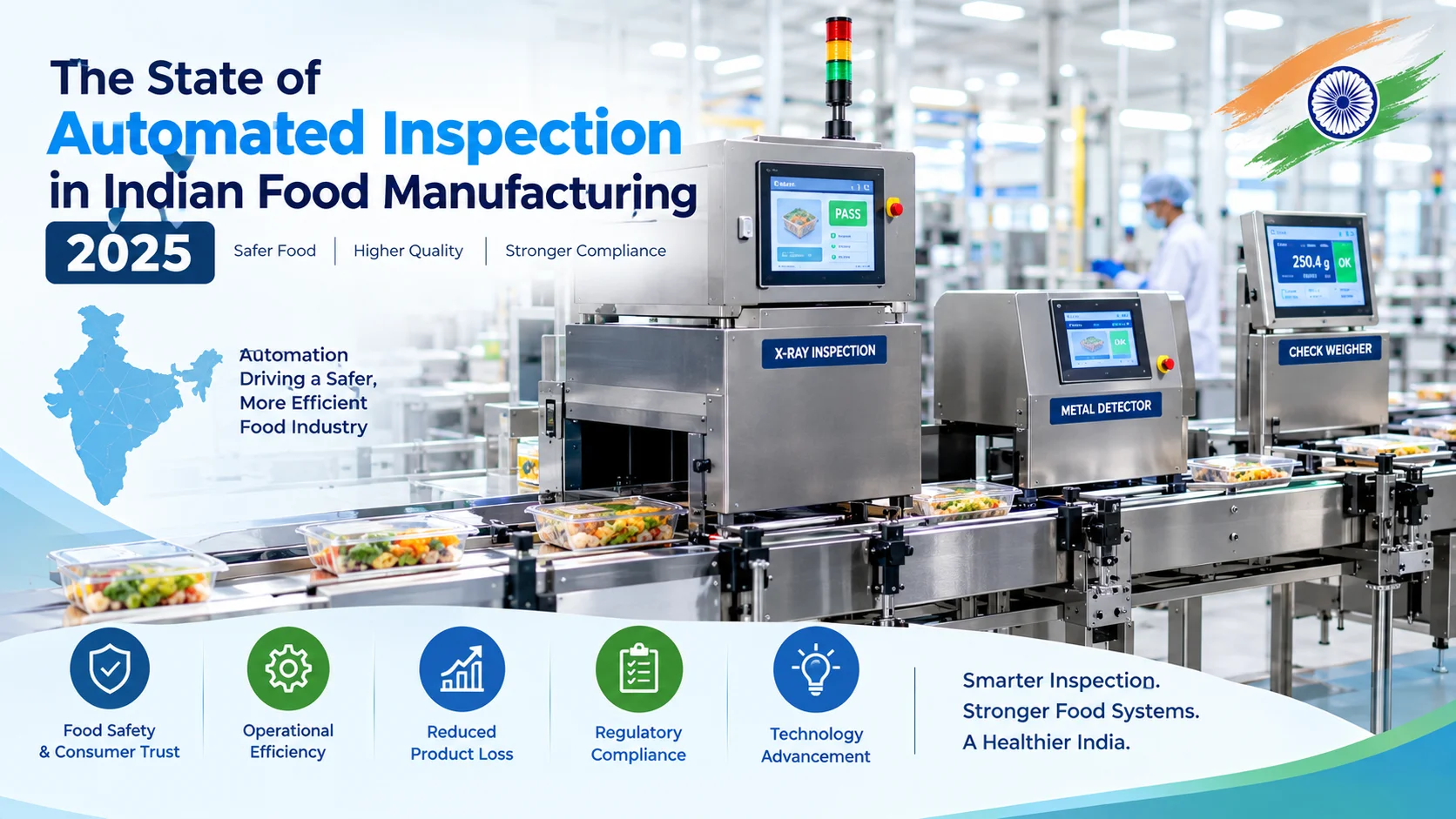
As packaged-food production becomes faster, product portfolios become more diverse and quality expectations increase, manufacturers are looking beyond manual inspection and periodic sampling. Automated inspection technologies are increasingly becoming part of the production-line strategy for detecting foreign bodies, controlling product weight, checking packaging and identifying visual defects.
For food manufacturers, the objective is not simply to automate inspection. The larger objective is to build a repeatable, measurable and integrated quality-control process that can operate alongside high-speed production.
Technologies such as metal detection, X-ray inspection, online check weighing, vision inspection and optical sorting are increasingly relevant to different stages of food production. The right combination depends on the product, packaging, production speed, contamination risks and quality requirements.
This report examines the role of automated inspection in Indian food manufacturing in 2025 and the factors manufacturers should consider when moving from manual quality checks toward automated inspection.
Why Automated Inspection Is Becoming More Important
Traditional food-quality inspection can involve a combination of operator checks, periodic sampling and end-of-line testing.
These methods remain important, but they have limitations when production speeds increase.
A production line may process thousands of units during the time between two manual inspections. If a foreign object, incorrect weight or packaging defect occurs between those inspection points, the issue may not be identified immediately.
Automated inspection addresses this challenge by placing inspection directly into the production process.
Instead of:
Produce → Sample → Inspect → React
manufacturers can move toward:
Produce → Inspect Continuously → Reject Automatically → Monitor
This approach can provide faster feedback and greater consistency across production.
What Does Automated Inspection Mean in Food Manufacturing?
Automated inspection refers to technologies that automatically evaluate products, packaging or process outputs according to predefined criteria.
Depending on the application, a food manufacturer may use automated systems for:
- Foreign-body detection
- Weight verification
- Product sorting
- Visual defect inspection
- Package inspection
- Fill-level verification
- Product counting
- Label verification
- Missing-product detection
- Contamination control
- Quality grading
No single inspection technology can address every type of defect.
For example, metal detectors are primarily designed to identify metallic contaminants, while X-ray systems can identify certain dense non-metallic contaminants as well. Vision systems are better suited to visible characteristics such as appearance, print, shape and packaging conditions.
This makes inspection-system selection an important engineering decision.
The Five Major Technologies Shaping Automated Food Inspection
1. Metal Detection
Metal detectors remain an important technology for identifying metallic foreign bodies in food products.
Depending on the system and application, metal detectors can identify:
- Ferrous metals
- Non-ferrous metals
- Stainless steel
They are commonly integrated into conveyorized production lines and can automatically reject products that trigger the configured detection criteria.
Metal detection can be particularly useful when the principal contamination risk is metallic and the product and packaging are suitable for electromagnetic detection.
TCT currently offers conveyor, gravity-feed, aluminium-foil and flow-through metal-detection configurations for different production applications.
2. X-Ray Inspection
X-ray inspection provides another approach to foreign-body detection.
Unlike conventional metal detection, X-ray inspection works by analyzing differences in X-ray attenuation and density.
Depending on the product and system configuration, X-ray inspection can be used to identify certain contaminants such as:
- Metal
- Glass
- Stone
- Bone
- Dense plastic
It can also support additional checks such as fill level, component presence and package integrity.
This makes X-ray particularly relevant where manufacturers need inspection capabilities beyond metallic contamination.
TCT offers standard X-ray inspection as well as X-ray inspection designed for bulk-material applications.
3. Online Check Weighing
Weight control is another major area of automation.
An online check weigher measures products dynamically as they move through the production or packaging line.
The system can identify products that fall outside predefined weight limits and automatically reject them.
Applications can include:
- Packaged food
- Bakery products
- Snacks
- Dairy products
- Beverages
- Rice and pulses
- Nutraceutical products
TCT's current portfolio includes standard online check weighers, high-speed systems, heavy-duty models, large-package systems, revolving check weighers and multi-tray weight sorting systems.
Automated weight verification can help manufacturers reduce dependence on manual sampling and improve control over underweight, overweight and product-giveaway issues.
4. Vision Inspection
Machine vision brings automated visual inspection into the production line.
A vision system can use industrial cameras, controlled lighting and image-processing software to evaluate characteristics that may otherwise require human observation.
Potential food-industry applications include:
- Product appearance
- Shape and size
- Colour consistency
- Packaging defects
- Missing components
- Label verification
- Print verification
- Product presence
- Seal or closure inspection
The effectiveness of a vision system depends on the complete imaging setup—not simply camera resolution.
Lighting, lens selection, product presentation, triggering, processing algorithms and line speed all contribute to inspection performance.
5. Optical Sorting and Colour Sorting
For products such as rice, grains, pulses, seeds and other bulk materials, optical sorting can provide automated classification based on visual characteristics.
Depending on the application, colour-sorting technology can help separate material according to characteristics such as:
- Colour
- Appearance
- Shape
- Visible foreign material
- Product quality differences
TCT's solutions portfolio currently includes chute-type colour sorting and optical belt colour sorting systems, alongside weighing, detection and material-handling technologies.
From Individual Machines to Integrated Inspection
One of the most important developments in automated inspection is the movement away from treating each machine as an isolated piece of equipment.
Modern production lines increasingly require different inspection technologies to communicate with one another.
A packaged-food line, for example, could potentially include:
Product Filling → Check Weighing → Metal Detection → Vision Inspection → Automatic Rejection → Packing
Another application may require:
Bulk Material → Optical Sorting → X-Ray Inspection → Weighing → Packaging
The correct architecture depends on the product and risk profile.
TCT's current solutions approach maps different inspection technologies to specific food applications such as bakery, beverages, rice and pulses, fruits and vegetables and packaged products.
True Care Technology's Role in Automated Food Inspection
True Care Technology provides inspection, detection, weighing and material-handling systems for food and beverage as well as pharmaceutical, nutraceutical, chemical and FMCG applications.
Its current food-industry solution portfolio includes technologies such as:
- Online Check Weighers
- Conveyor Metal Detectors
- X-Ray Inspection
- Vision Inspection
- Optical Colour Sorting
- Material Handling Systems
TCT's current solutions framework maps these technologies to applications including bakery, beverages, rice and pulses, fruits and vegetables and packaged products.
The company describes its approach as beginning with a line audit covering production throughput, product characteristics and compliance requirements before engineering and commissioning the appropriate system.