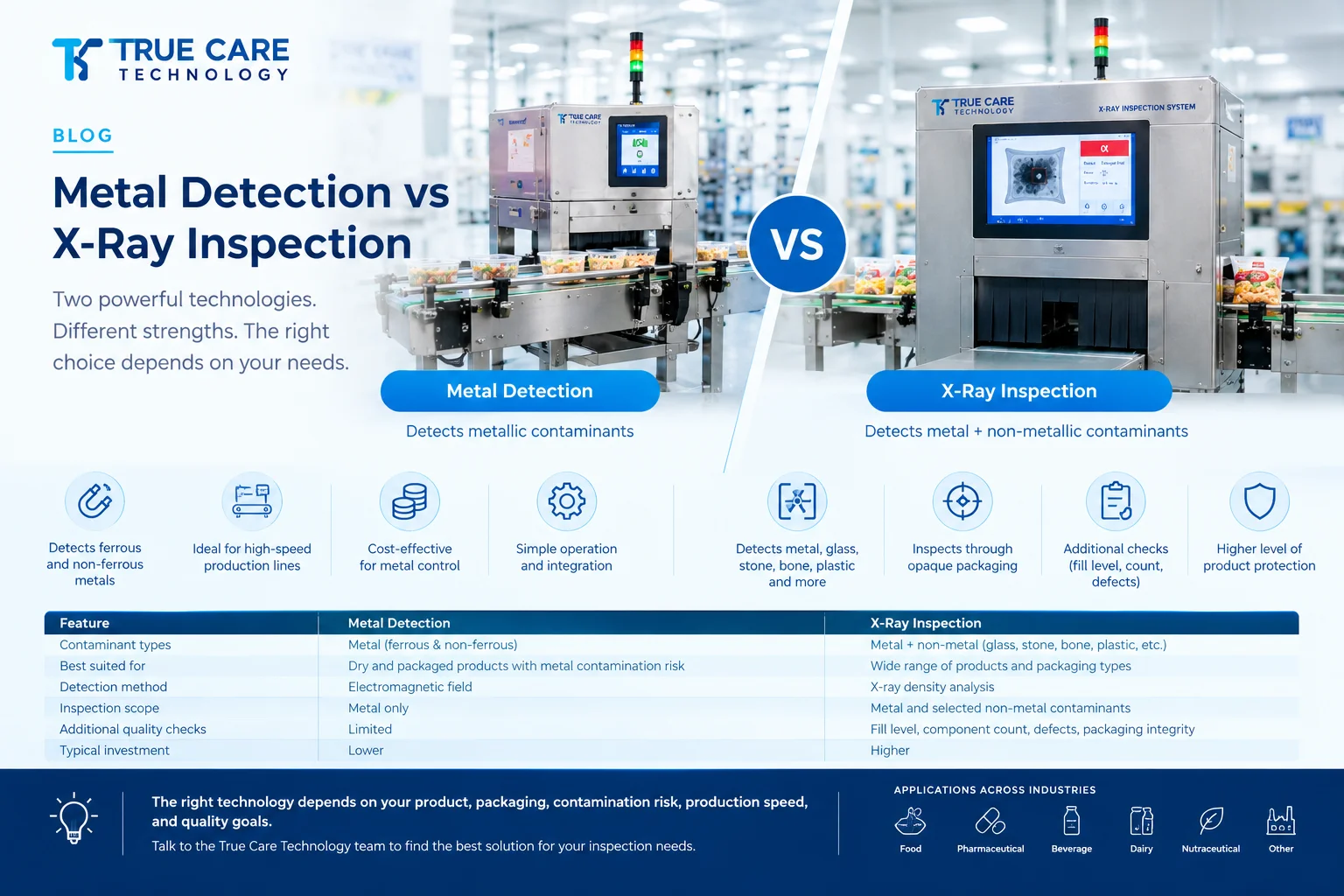
Metal detection and X-ray inspection are two widely used technologies for controlling foreign-body contamination. While both can detect metallic contaminants, they use fundamentally different inspection principles and offer different capabilities.
Choosing between them should not be based simply on machine price or detection sensitivity.
The right technology depends on your product, packaging, contamination risks, production speed, inspection requirements, quality objectives and overall production-line configuration.
For food, pharmaceutical and nutraceutical manufacturers, understanding the difference between metal detection and X-ray inspection is essential when designing an effective inspection strategy.
What Is Metal Detection?
A metal detector uses an electromagnetic field to identify conductive metallic contaminants as products pass through the inspection aperture.
When a metallic object enters the detector's electromagnetic field, it creates a measurable disturbance. The system analyzes this signal and determines whether the product contains a detectable metallic contaminant.
Depending on the equipment and application, metal detectors can identify:
- Ferrous metals
- Non-ferrous metals
- Stainless steel
True Care Technology offers metal detection solutions for applications including pharmaceutical products, bottles, liquids and packaged products, as well as aluminium-foil applications.
Typical Metal Detection Process
Product → Electromagnetic Field → Signal Analysis → Metal Detected → Automatic Rejection
When contamination is detected, an integrated rejection mechanism can remove the affected product from the production stream.
What Is X-Ray Inspection?
X-ray inspection systems use X-rays to examine differences in material density as products pass through the inspection system.
Instead of relying on electrical conductivity, the system analyzes the attenuation of X-rays through the product.
This allows X-ray inspection to identify certain dense foreign materials that a conventional metal detector cannot detect.
Depending on the application, X-ray systems can identify:
- Metal
- Glass
- Stone
- Bone
- Dense plastic
- Ceramic
- Other dense foreign materials
X-ray systems can also be configured for additional inspection functions such as fill-level checking, component counting and selected product or packaging-defect detection. TCT's standard X-ray system is positioned for these types of inspection applications.
Metal Detector or X-Ray? A Practical Decision Framework
Use these questions when evaluating your production line.
Question 1: What contaminants are you trying to detect?
Metal only?
Consider metal detection.
Metal + glass/stone/bone/dense non-metal contaminants?
Evaluate X-ray inspection.
Question 2: What is your packaging?
Conventional plastic, paperboard or suitable packaging?
Both technologies may be possible depending on the product.
Aluminium, metallized or challenging packaging?
Evaluate whether conventional metal detection will provide the required performance or whether X-ray is more appropriate.
Question 3: What is your product?
Consider:
- Moisture
- Conductivity
- Density
- Product temperature
- Product dimensions
- Product orientation
- Packaging format
These characteristics can significantly influence inspection performance.
Question 4: Do you need additional quality checks?
If you only need metallic-contamination detection, metal detection may be sufficient.
If you also require checks such as:
- Fill level
- Component count
- Certain product defects
- Selected packaging defects
X-ray may provide additional functionality.
Question 5: What does your customer require?
Some retailers, brands or contract manufacturers may specify particular inspection technologies in their supplier requirements.
Therefore, manufacturers should review applicable customer specifications before selecting equipment.
Metal Detection vs. X-Ray: The Bottom Line
There is no universal winner between metal detection and X-ray inspection.
The appropriate technology depends on what you need to detect and how your production line operates.
Metal Detection may be appropriate when:
- Metal is the primary contamination risk
- High-speed inspection is required
- The product is suitable for electromagnetic detection
- A focused and relatively straightforward inspection system is required
- Pharmaceutical tablets or capsules are being inspected
X-Ray Inspection may be appropriate when:
- Foreign-body risks extend beyond metals
- Glass, stone, bone or certain dense plastics are concerns
- Packaging creates challenges for conventional metal detection
- Additional checks such as fill level or component presence are valuable
- A broader inspection capability is required
Why Choose True Care Technology?
True Care Technology provides inspection and detection systems for food, pharmaceutical, nutraceutical, chemical, FMCG and other manufacturing applications. Its current portfolio includes metal detectors, X-ray inspection systems, online check weighers and combination inspection systems.
TCT's approach is to evaluate the actual production application before recommending an inspection solution, considering factors such as:
- Product characteristics
- Packaging
- Contamination risks
- Production speed
- Detection requirements
- Existing equipment
- Hygiene requirements
- Quality and compliance requirements
This application-based approach helps manufacturers select inspection technology based on their actual production conditions rather than simply comparing machine specifications.