
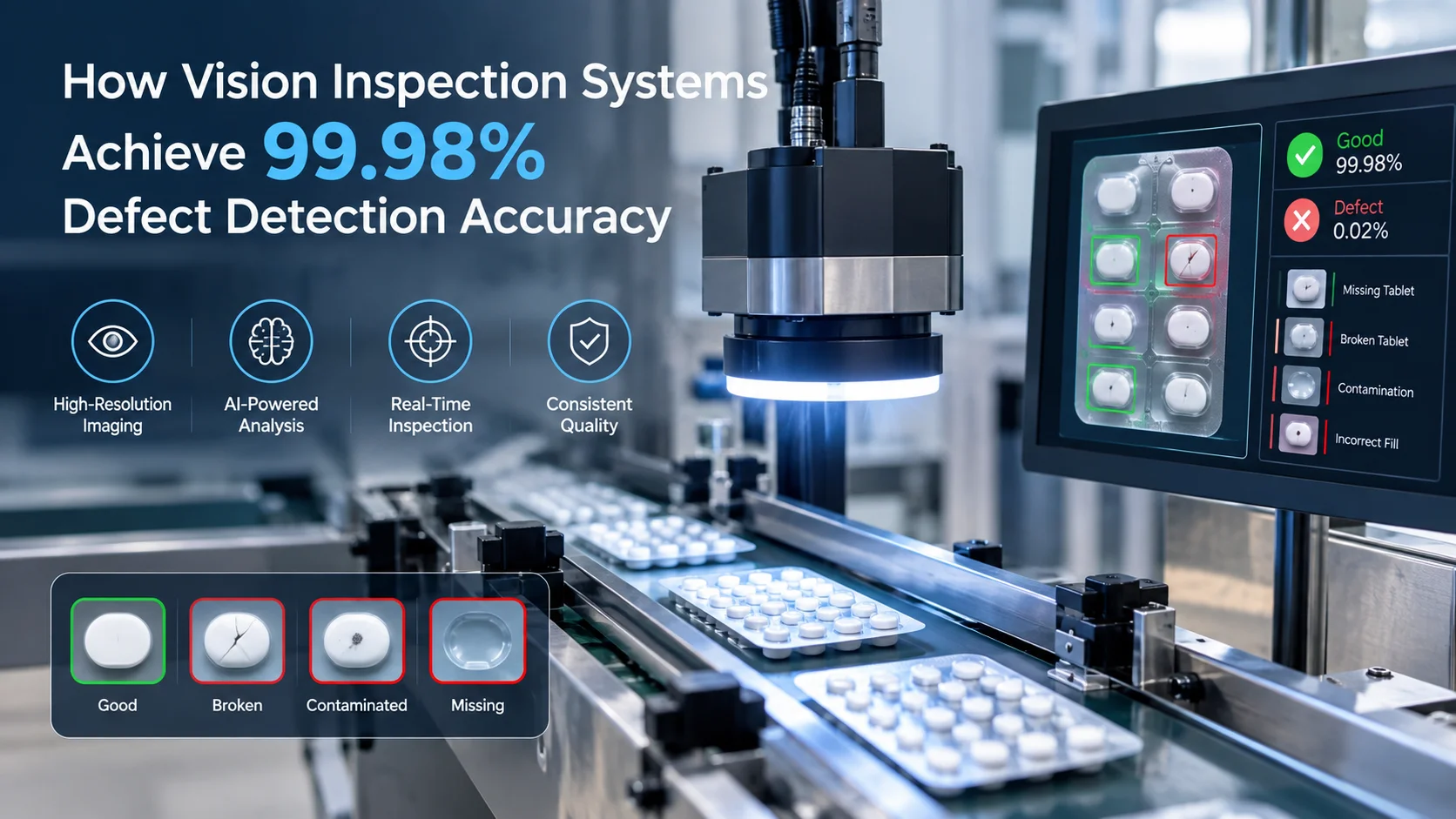
Modern manufacturing lines are expected to maintain consistent product quality while operating at high speeds. Manual inspection alone can make it difficult to identify every visual defect, especially when products are moving continuously through automated packaging and production equipment.
Vision inspection systems address this challenge by combining industrial cameras, controlled illumination, image processing and inspection software to examine products automatically and consistently. However, achieving very high detection performance is not simply a matter of installing a higher-resolution camera. Camera selection, lighting, product presentation, inspection algorithms, line speed, triggering and rejection accuracy all have to work together.
The 99.98% detection figure associated with some vision-inspection applications should therefore be understood as an application-specific performance target rather than a universal guarantee. Actual results depend on the product, defect type, machine configuration, validation method and production environment.
What Is a Vision Inspection System?
A vision inspection system is an automated quality-control solution that uses cameras and image-processing software to inspect products or packaging as they move through a production line.
Depending on the application, a system can verify:
- Product presence or absence
- Shape and size
- Colour consistency
- Broken or chipped products
- Surface defects
- Missing components
- Incorrect product placement
- Printed characters and codes
- Label or packaging conditions
- Foreign particles or visible abnormalities
For pharmaceutical applications, for example, vision systems can inspect blister packs for missing, broken, chipped or incorrectly positioned tablets and capsules. TCT's Blister Inspection System is designed for these types of checks and can automatically signal the rejection of non-conforming products.
How Does Vision Inspection Work?
A typical automated vision inspection process consists of five major stages.
1. Product Detection and Triggering
A sensor or encoder detects when the product reaches the inspection position. The camera is triggered at the correct moment so that the image is captured consistently.
Precise triggering becomes particularly important at high production speeds. Poor synchronization can result in motion blur, inconsistent product positioning or missed inspection windows.
2. Image Acquisition
An industrial camera captures an image of the product.
Camera selection depends on factors such as:
- Product dimensions
- Required defect size
- Line speed
- Field of view
- Working distance
- Required image detail
- Monochrome or colour inspection requirements
Higher resolution can provide more image detail, but resolution alone does not determine inspection performance.
3. Controlled Illumination
Lighting is one of the most important parts of a reliable vision system.
The lighting arrangement is selected according to the defect being inspected. Different applications may require:
- Diffused lighting
- Backlighting
- Area lighting
- Bar lighting
- Ring lighting
- Dark-field illumination
- Controlled contrast lighting
The objective is to make the relevant defect clearly distinguishable from the acceptable product.
For example, a small surface crack may become much easier to identify when lighting creates sufficient contrast between the defect and the surrounding surface.
4. Image Processing and Classification
The captured image is processed by inspection software.
Depending on the application, the software can perform operations such as:
- Pattern matching
- Edge detection
- Measurement
- Colour analysis
- Shape analysis
- Character recognition
- Character verification
- Presence/absence checking
- Defect classification
- Template comparison
More advanced systems can use intelligent classification techniques to distinguish acceptable variations from genuine defects.
TCT's vision solutions include OCR/OCV inspection, product recipe management, batch reporting, rejected-image management and machine diagnostics for suitable pharmaceutical applications.
5. Automatic Decision and Rejection
Once the inspection algorithm determines whether the product meets the configured criteria, the machine communicates the result to the line-control system.
A non-conforming product can then be automatically rejected.
This closed-loop process is important because detecting a defect is only part of quality control. The system must also reliably associate the inspection result with the correct product and remove the rejected item without disturbing good production.
The Key Factors Behind High Detection Accuracy
Camera Resolution
Camera resolution determines how much visual information can be captured.
A higher-resolution camera can be beneficial when inspecting small defects, fine print or detailed product features. However, selecting the highest available resolution is not always the best solution.
The correct camera should be selected according to:
- Defect dimensions
- Product size
- Field of view
- Required pixels per feature
- Line speed
- Processing capacity
A carefully designed lower-resolution system can outperform a poorly configured high-resolution system if the lighting, optics and image processing are better matched to the application.
Lighting Geometry
Lighting can have as much influence on inspection performance as the camera.
Consider a scratched surface. If the lighting creates little contrast between the scratch and the surrounding material, even a high-resolution camera may struggle to identify it.
By changing the lighting angle or using controlled illumination, the same defect may become significantly easier to classify.
This is why machine-vision system design should begin with the inspection requirement rather than simply selecting a camera.
Lens Selection
The lens determines how the camera sees the product.
Important considerations include:
- Working distance
- Field of view
- Magnification
- Distortion
- Depth of field
- Product dimensions
An unsuitable lens can introduce distortion or insufficient image detail, reducing the effectiveness of the inspection system.
Product Positioning
Consistent product presentation is essential.
If products rotate, move laterally or change orientation unpredictably, the inspection algorithm may receive significantly different images from one product to another.
Mechanical guides, conveyors, fixtures, timing systems and product-handling mechanisms therefore contribute directly to inspection reliability.
Line Speed
A vision system must be capable of processing images within the available inspection window.
At higher speeds, the system needs:
- Fast image acquisition
- Accurate triggering
- Appropriate exposure settings
- Sufficient processing power
- Reliable communication
- Fast rejection response
TCT's marking and inspection solution, for example, integrates high-speed vial handling, industrial vision inspection and automatic rejection for pharmaceutical applications, illustrating how vision technology must operate as part of the complete production system rather than as an isolated camera.
Vision Inspection in Pharmaceutical Manufacturing
Vision Inspection in Pharmaceutical Manufacturing
Pharmaceutical manufacturing is one of the strongest applications for machine vision because product quality often depends on identifying small physical and packaging defects.
Typical applications include:
Blister Inspection
Vision systems can inspect blister packs for:
- Missing tablets or capsules
- Broken tablets
- Chipped tablets
- Colour variations
- Size variations
- Incorrect product placement
- Foreign particles
TCT's blister inspection solution is designed to inspect individual blister pockets and can integrate automatic rejection and reporting functions.