
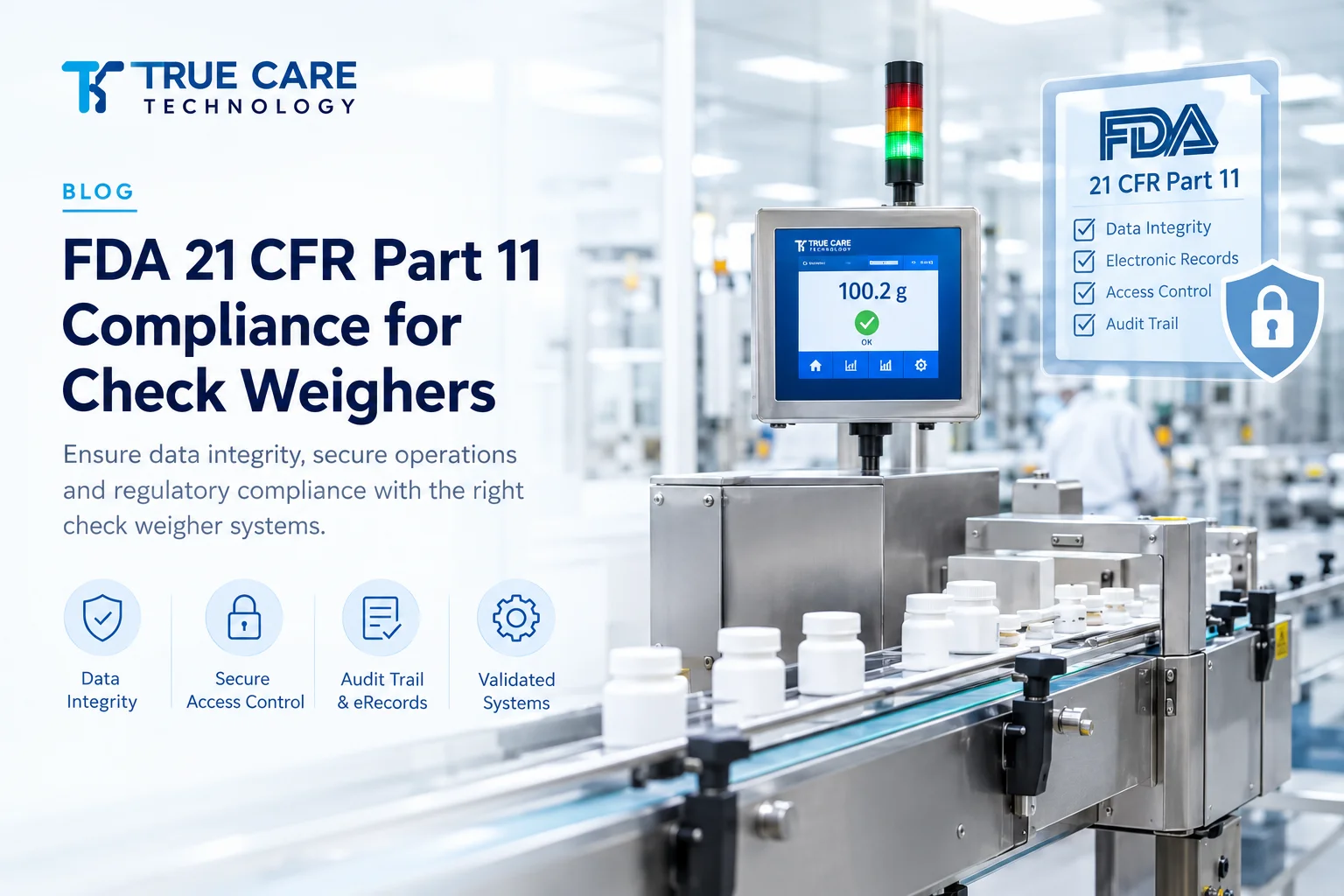
Electronic records, audit trails, user access and electronic signatures are increasingly important when check weighers are integrated into pharmaceutical manufacturing and quality systems.
In modern pharmaceutical manufacturing, check weighing is more than simply measuring whether a product falls within a specified weight range. When an automated check weigher generates, stores, modifies or transfers electronic records that are relied upon for regulated activities, the computerized system may fall within the scope of FDA 21 CFR Part 11.
For manufacturers operating under FDA-regulated processes, this means that the check-weighing system should be designed and managed with appropriate controls for data integrity, access, auditability and electronic records.
This guide explains the key areas pharmaceutical manufacturers should consider when evaluating a check weigher and its associated software.
What Is FDA 21 CFR Part 11?
21 CFR Part 11 establishes criteria under which FDA considers certain electronic records and electronic signatures to be trustworthy, reliable and generally equivalent to paper records and handwritten signatures. It applies to qualifying electronic records created, modified, maintained, archived, retrieved or transmitted under applicable regulatory requirements.
For a pharmaceutical check-weighing system, the important question is therefore not simply:
“Does the check weigher have a digital display?”
Instead, manufacturers should ask:
“How are the electronic weighing records created, controlled, stored, changed, reviewed and retrieved?”
This distinction is important when selecting or validating automated inspection equipment.
Why Does Part 11 Matter for Check Weighers?
A modern check weigher can generate valuable production information, including:
- Product weight
- Batch or product information
- Pass/fail results
- Reject information
- Operator activity
- Machine settings
- Calibration-related information
- Production statistics
- Date and time information
- System events and alarms
When such information forms part of regulated electronic records, appropriate controls are needed to protect its authenticity and integrity.
FDA's Part 11 framework includes controls relating to system validation, access restriction, audit trails, record protection, operational checks, authority checks, training and electronic signatures.
Seven Key Part 11 Considerations for Check Weighers
1. Electronic Record Integrity
Electronic weighing data should be protected against unauthorized modification or deletion.
A suitable computerized system should provide appropriate controls so that records remain accurate, reliable and available throughout the applicable retention period.
For example, a pharmaceutical manufacturer may need to retain information associated with a production batch and subsequently retrieve that information during an internal quality review or regulatory inspection.
The system should therefore provide controlled access to the records and an appropriate method of retrieval.
FDA's regulations require controls designed to ensure the authenticity, integrity and, where appropriate, confidentiality of electronic records.
2. User Access Control
Not every operator should necessarily have unrestricted access to every check-weigher function.
A role-based access structure can help separate activities according to user responsibilities.
For example:
User RoleTypical Access
Operator | Production operation and basic monitoring
Supervisor | Production settings and review
Quality | Record review and quality-related functions
Administrator | System configuration and controlled administration
Operator | Production operation and basic monitoring
Supervisor | Production settings and review
Quality | Record review and quality-related functions
Administrator | System configuration and controlled administration
The exact access structure should be established according to the manufacturer's quality system and risk assessment.
21 CFR 11.10 specifically addresses limiting system access to authorized individuals and using authority checks to ensure that only authorized users can perform specified operations.
3. Audit Trails
An audit trail is one of the most important features to evaluate when a check-weighing system is used to maintain regulated electronic records.
A secure, computer-generated, time-stamped audit trail can record relevant operator actions and changes to electronic records.
Depending on the system, this could include events such as:
- Login activity
- Changes to product parameters
- Changes to operating limits
- Configuration changes
- Record modifications
- User activity
- System events
- Electronic approvals
A key principle is that changing a record should not simply overwrite the previous information without preserving an appropriate history.
21 CFR 11.10(e) addresses secure, computer-generated, time-stamped audit trails and requires changes not to obscure previously recorded information.
FDA guidance also explains that audit trails can be particularly appropriate where users create, modify or delete regulated records during normal operation.
4. Electronic Signatures
If electronic signatures are used as the equivalent of handwritten signatures for regulated activities, the system must incorporate the applicable Part 11 controls.
Electronic signatures should be:
- Uniquely associated with an individual
- Protected from unauthorized use
- Linked appropriately to the associated record
- Controlled through appropriate identification and authentication mechanisms
21 CFR 11.100 requires electronic signatures to be unique to an individual and requires verification of the individual's identity before the electronic signature is established or assigned.
Electronic signatures are therefore more than simply entering a username into a touchscreen.
5. System Validation
A check weigher may be physically accurate, but that alone does not establish compliance of the associated computerized system.
Where Part 11 applies, 21 CFR 11.10(a) calls for validation of systems to ensure accuracy, reliability, consistent intended performance and the ability to discern invalid or altered records.
Validation should therefore consider the complete intended use of the system.
Depending on the application, this can involve:
User Requirements → Functional Requirements → Risk Assessment → Installation Qualification → Operational Qualification → Performance Qualification → Validation Documentation
The precise validation approach should be established according to the manufacturer's quality system, intended use and applicable regulatory requirements.
6. Secure Record Retention and Retrieval
Electronic records are useful only when they can be reliably retrieved when required.
A compliant computerized environment should consider:
- Record retention requirements
- Data backup
- Data security
- Controlled deletion
- Data retrieval
- Human-readable records
- Electronic copies
- System availability
21 CFR 11.10 addresses protection of records so they remain accurately and readily retrievable throughout the applicable retention period.
Manufacturers should also establish procedures describing how records are archived, restored and made available for review.
7. System and Device Controls
Part 11 also addresses operational, authority and device checks.
For a check-weighing application, manufacturers should evaluate whether the computerized system can appropriately control:
- Authorized operations
- User permissions
- System inputs
- Connected devices
- Defined process sequences
- Configuration changes
- Critical system functions
These controls help ensure that electronic records are generated by an appropriately controlled system rather than through uncontrolled manual intervention.