
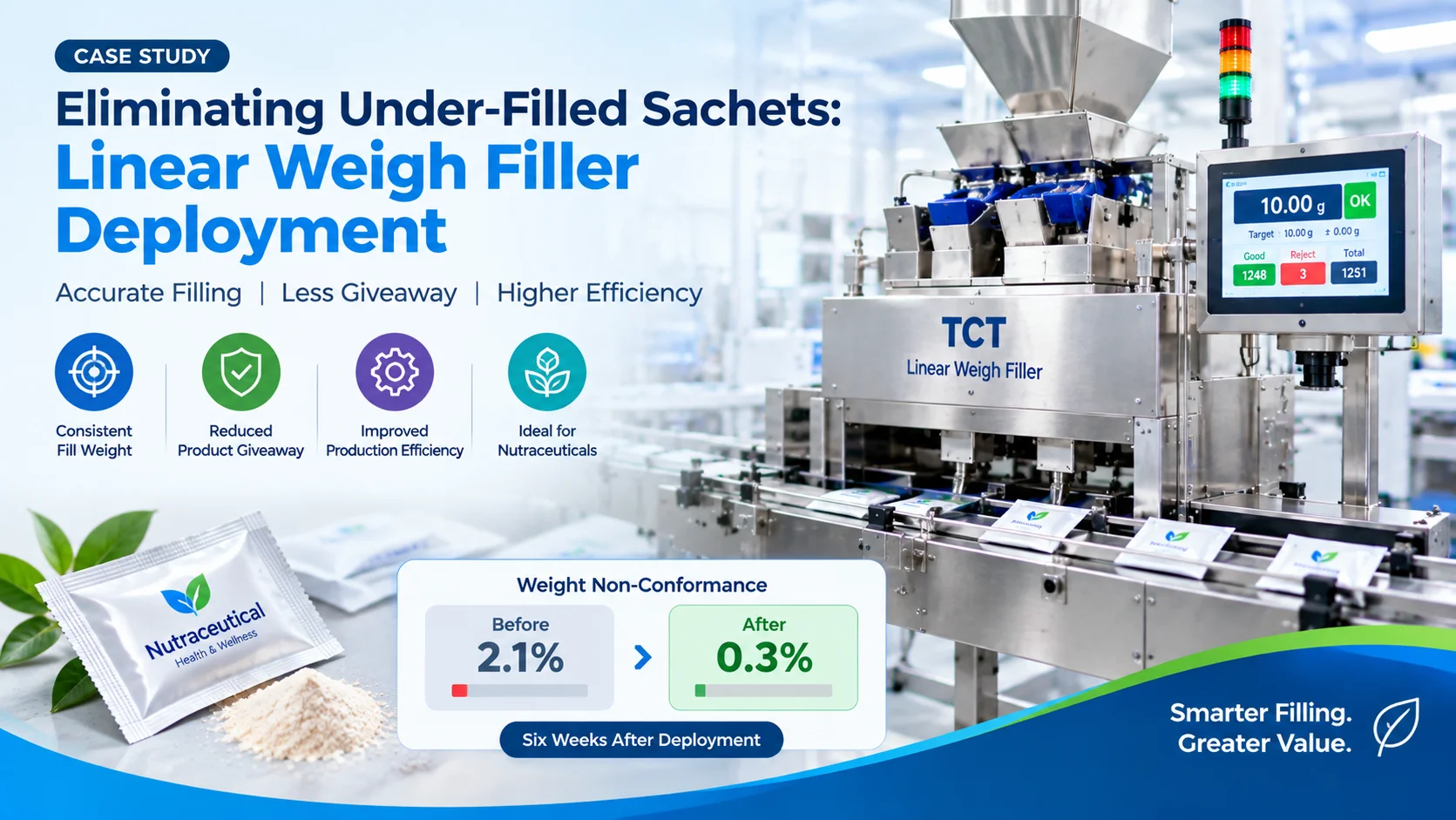
In nutraceutical packaging, maintaining consistent fill weight is critical for product quality, customer expectations and control of material giveaway. Even relatively small variations in individual sachets can accumulate into significant product losses across a high-volume production run.
A Pune-based nutraceutical manufacturer was experiencing this challenge in its sachet packaging operation. Approximately 2.1% of production was being affected by weight non-conformance, creating both product giveaway and operational inefficiencies.
The manufacturer deployed a linear weigh filler to improve the consistency of product dosing and filling.
Six weeks after deployment, the reported giveaway had fallen from 2.1% to 0.3%.
This case study examines the problem, the role of linear weighing, the deployment approach and the lessons that other nutraceutical manufacturers can take from the implementation. The reported 2.1% and 0.3% figures are specific to this case study and should not be interpreted as a guaranteed result for every application.
The Packaging Challenge: Under-Filled Sachets and Product Giveaway
Sachet filling requires a controlled and repeatable method of dosing product into each package.
When the filling process relies heavily on uncontrolled or inconsistent volumetric feeding, variations in:
- Product density
- Particle size
- Moisture
- Flowability
- Material distribution
- Feeding rate
- Hopper level
can influence the amount of product entering an individual sachet.
For a nutraceutical manufacturer, under-filled sachets can result in products falling outside the intended weight specification.
At the same time, operators may compensate for under-filling by increasing the target fill quantity. This can create a second problem: overfilling and product giveaway.
The challenge is therefore not simply to avoid under-filled packs. The objective is to achieve a controlled target weight while maintaining consistent production.
The Starting Point: 2.1% Weight Non-Conformance
The Pune nutraceutical manufacturer was experiencing approximately 2.1% production loss associated with weight non-conformance.
At production scale, even a seemingly small percentage can represent a meaningful quantity of product.
For products containing relatively expensive ingredients, unnecessary giveaway can directly affect packaging economics.
The manufacturer therefore needed a filling approach that could provide:
- More consistent dosing
- Better control over target weight
- Reduced variation between fills
- Improved production efficiency
- Easier operator control
- A more repeatable filling process
Rather than treating the problem purely as an inspection issue, the focus shifted toward controlling the filling process itself.
Why Linear Weigh Filling Was Considered
A linear weigh filler uses weighing as part of the filling process.
Instead of relying only on a predetermined volume, the system feeds product into a weighing hopper equipped with a load cell. Once the configured target weight is reached, the weighed quantity is discharged into the package.
This creates a direct relationship between the target fill weight and the quantity being dispensed.
The current TCT Linear Weigh Filler is designed for granular, free-flowing and semi-free-flowing products and uses one, two or four linear vibratory feeders depending on the configuration. Product flow is independently controlled into load-cell-equipped weighing hoppers before discharge.
How a Linear Weigh Filler Works
A simplified filling sequence is:
Product Supply → Controlled Feeding → Weigh Hopper → Target Weight Reached → Product Discharge → Sachet Filling
Step 1: Product Feeding
Product is supplied to the filling system from the main product hopper.
Product is supplied to the filling system from the main product hopper.
Step 2: Controlled Vibratory Feeding
Linear vibratory feeders regulate the movement of product toward the weighing hopper.
The vibration intensity can be adjusted according to the characteristics of the product.
Step 3: Weight Measurement
The product enters a weighing hopper equipped with a load cell.
The system continuously monitors the weight as the hopper is filled.
Step 4: Target Weight Reached
Once the configured target weight is reached, the feeding process is controlled to stop or transition according to the machine's filling logic.
Step 5: Discharge
The weighed quantity is discharged into the waiting pouch, sachet or container.
Step 6: Repeat
The weighing hopper returns to the filling cycle for the next package.
This process allows the filling operation to be controlled around an actual measured weight rather than relying exclusively on volume.
How True Care Technology Supports Dosing & Filling Applications
How True Care Technology Supports Dosing & Filling Applications
True Care Technology provides dosing and filling equipment designed for different product and production requirements.
Its current dosing and filling portfolio includes:
- Linear Weigh Filler Machine
- 12 Head Multi-Head Weigher Filler
- Dosing System – Weigh-in-Loss System
The Linear Weigh Filler is positioned for granular, free-flowing and semi-free-flowing products and is available in one-, two- and four-head configurations.
TCT also maps linear weighing applications to nutraceutical products such as protein and health powders, alongside other weighing, transfer and inspection technologies.
The appropriate system should be selected after considering the product characteristics, target fill weight, throughput, packaging format, hygiene requirements and integration requirements.