
A Real-World Case Study of Automated Capsule Weight Verification
In pharmaceutical manufacturing, even small variations in capsule fill weight can create significant quality and production challenges.
Traditional quality-control processes often rely on periodic manual sampling. While sampling can provide useful process information, it does not continuously evaluate every capsule coming from a filling machine. Variations that occur between sampling points can therefore remain undetected until the next quality check.
A Gujarat-based pharmaceutical capsule-filling operation faced this challenge and replaced manual sampling with an inline TCW-T1200 capsule check weigher from True Care Technology.
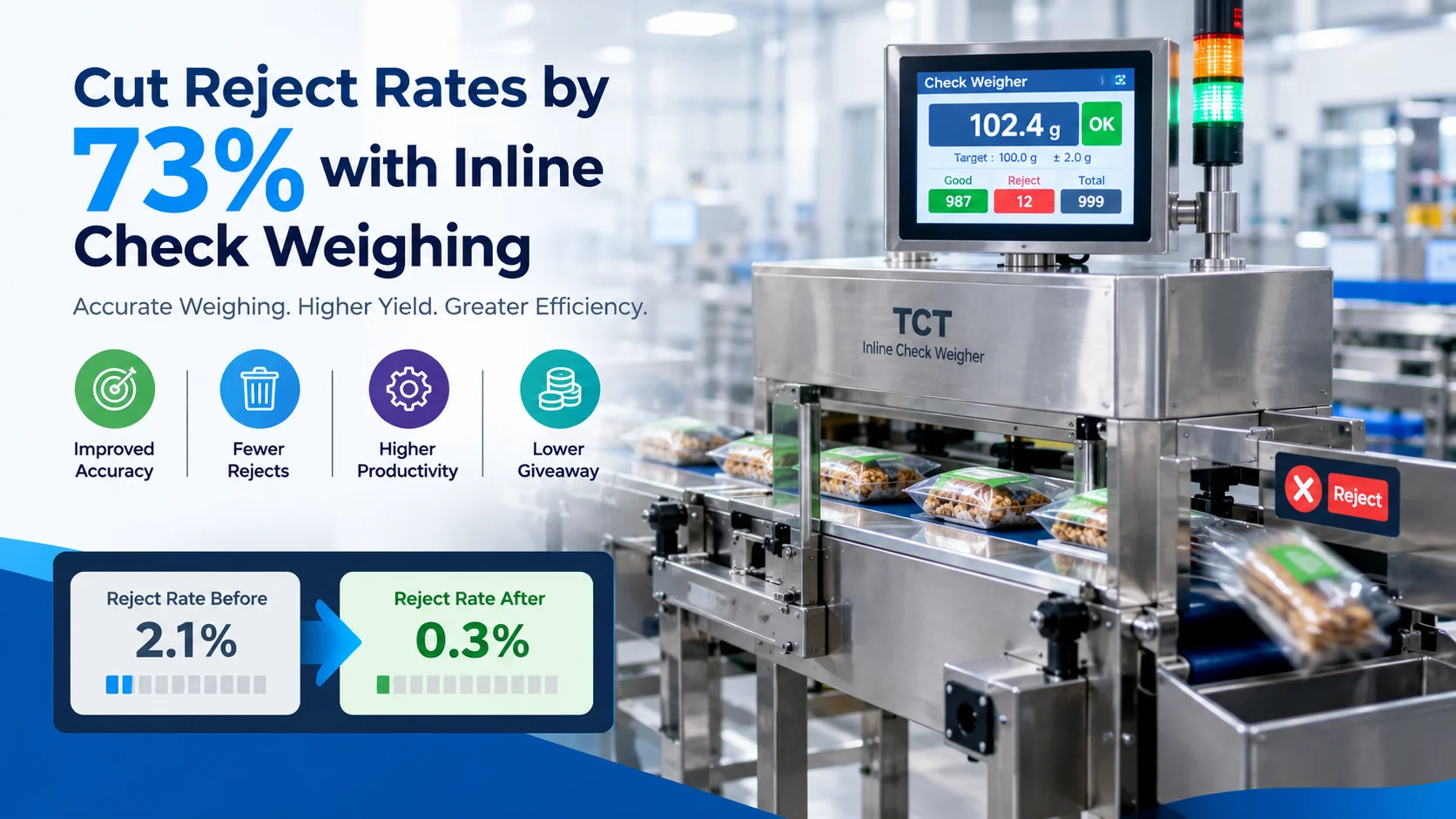
The resulting case study reported a 73% reduction in reject rates, with the implementation and return-on-investment evaluation tracked over an 18-month production period.
This case demonstrates how moving from periodic sampling to automated inline weight verification can change the way pharmaceutical manufacturers manage capsule-filling quality.
The Challenge: Manual Sampling Could Not Monitor Every Capsule
Before automation, the manufacturer relied on manual sampling to verify capsule weights.
This approach has an inherent limitation: a sample represents only a portion of production.
A capsule-filling line can produce thousands of capsules during a production run. If a variation develops between two manual sampling checks, affected capsules may continue through the process before the issue is identified.
This can result in:
- Increased product rejection
- Greater batch variability
- Additional investigation
- Product rework or segregation
- Increased operator involvement
- Potential material loss
- Reduced confidence in continuous weight control
For pharmaceutical manufacturers, the objective is not simply to measure weight. The goal is to maintain a controlled filling process and identify individual units that fall outside the configured acceptance criteria.
The Solution: Inline Capsule Check Weighing
The manufacturer introduced a TCW-T1200 inline check weigher into the capsule production process.
Instead of depending exclusively on periodic manual sampling, the automated system performs weight verification as capsules move through the inspection process.
True Care Technology's tablet/capsule check-weigher portfolio is designed to verify the filling quantity of individual capsules and automatically identify products that do not meet configured weight criteria.
This changes the quality-control approach from:
Periodic Sampling → Detect Process Variation Later
to:
Continuous Inline Verification → Identify Individual Out-of-Specification Units
The difference can have a significant effect on production control.
How Inline Capsule Check Weighing Works
The basic process can be divided into several stages.
1. Capsule Feeding
Capsules are transferred into the check-weighing system and organized into controlled channels.
Consistent product handling is important because the weighing system must receive capsules in a predictable manner.
Capsules are transferred into the check-weighing system and organized into controlled channels.
Consistent product handling is important because the weighing system must receive capsules in a predictable manner.
2. Individual Weight Measurement
Each capsule is weighed dynamically according to the configured operating parameters.
The TCW tablet/capsule check-weigher range is designed for pharmaceutical, API, nutraceutical, confectionery, food and Ayurveda applications. The current product specification lists a detection range of 10–2000 mg, with model-dependent channel capacity and throughput.
3. Comparison Against Weight Limits
The measured weight is compared with the configured acceptable range.
Depending on the application, the system can identify capsules that are:
- Underweight
- Overweight
- Outside the defined tolerance
- Otherwise unsuitable according to the configured inspection criteria
4. Automatic Rejection
Non-conforming capsules can be automatically removed from the production flow.
The TCW series supports rejection mechanisms such as air jets, flippers and pushers, depending on the configuration.
This is important because identifying a defective unit without reliably removing it does not complete the quality-control process.
Why Inline Weighing Can Reduce Rejects
It may initially seem counterintuitive that installing an automated reject system can reduce the overall reject rate.
The key is earlier and more precise identification of process variation.
When a production line relies on periodic sampling, an emerging filling problem may affect multiple capsules before the next sample identifies the issue.
With inline verification, abnormal individual units can be identified continuously.
This allows manufacturers to:
- Detect individual weight deviations.
- Remove non-conforming capsules.
- Monitor trends in the filling process.
- Identify developing process variation.
- Adjust the filling process before larger quantities are affected.
The result is a shift from batch-level reaction toward continuous process control.
The 73% Reduction: What the Case Study Shows
The referenced TCT case study reports a 73% reduction in reject rates following the transition to inline check weighing.
This figure should be interpreted in the context of the specific installation.
Actual reject-rate improvements will depend on factors such as:
- Initial reject rate
- Capsule formulation
- Filling-machine performance
- Product characteristics
- Weight tolerance
- Production speed
- Operator practices
- Calibration
- Preventive maintenance
- Integration between the filler and check weigher
Therefore, the 73% figure is best viewed as a documented case-study outcome rather than a guaranteed result for every pharmaceutical production line.
How True Care Technology Supports Inline Weighing
How True Care Technology Supports Inline Weighing
True Care Technology offers a range of online check-weighing systems for pharmaceutical, food, nutraceutical, chemical and other manufacturing applications. Its product range includes standard online check weighers, high-speed systems, heavy-duty models, large-package systems, revolving check weighers, multi-tray weight sorting machines and tablet/capsule check weighers.
For capsule and tablet applications, the TCW range provides configurable channel counts and production capacities, allowing the equipment to be matched to different throughput requirements.
The appropriate configuration should be selected based on the actual product, required accuracy, throughput, line configuration and validation requirements.