
On 5 October 2026, Hovione said it will commission a $35 million continuous direct- compression tableting line, built with GEA, at a single US site. The company pointed to the 2022 adoption of ICH Q13, the harmonised guideline on continuous manufacturing, and reported that FDA had approved 17 products under it as of 2024 (PharmTech).
Every continuous line like this starts the same way. In continuous manufacturing, input materials are added steadily through a feeder system, typically loss-in-weight feeders for solid powders (Hogan Lovells). The same principle also runs continuous mixing in food, chemical, plastics and fertiliser plants. This guide explains how a loss in weight feeder
works and when to choose one.
Volumetric vs gravimetric feeding
There are two ways to feed a powder continuously.
A volumetric feeder assumes every screw turn delivers the same amount. In practice, powder density changes as the hopper empties, as humidity changes and as material settles. The feed rate drifts without anyone noticing.
A gravimetric feeder measures what actually leaves, by weight, and corrects itself continuously.
How loss-in-weight works
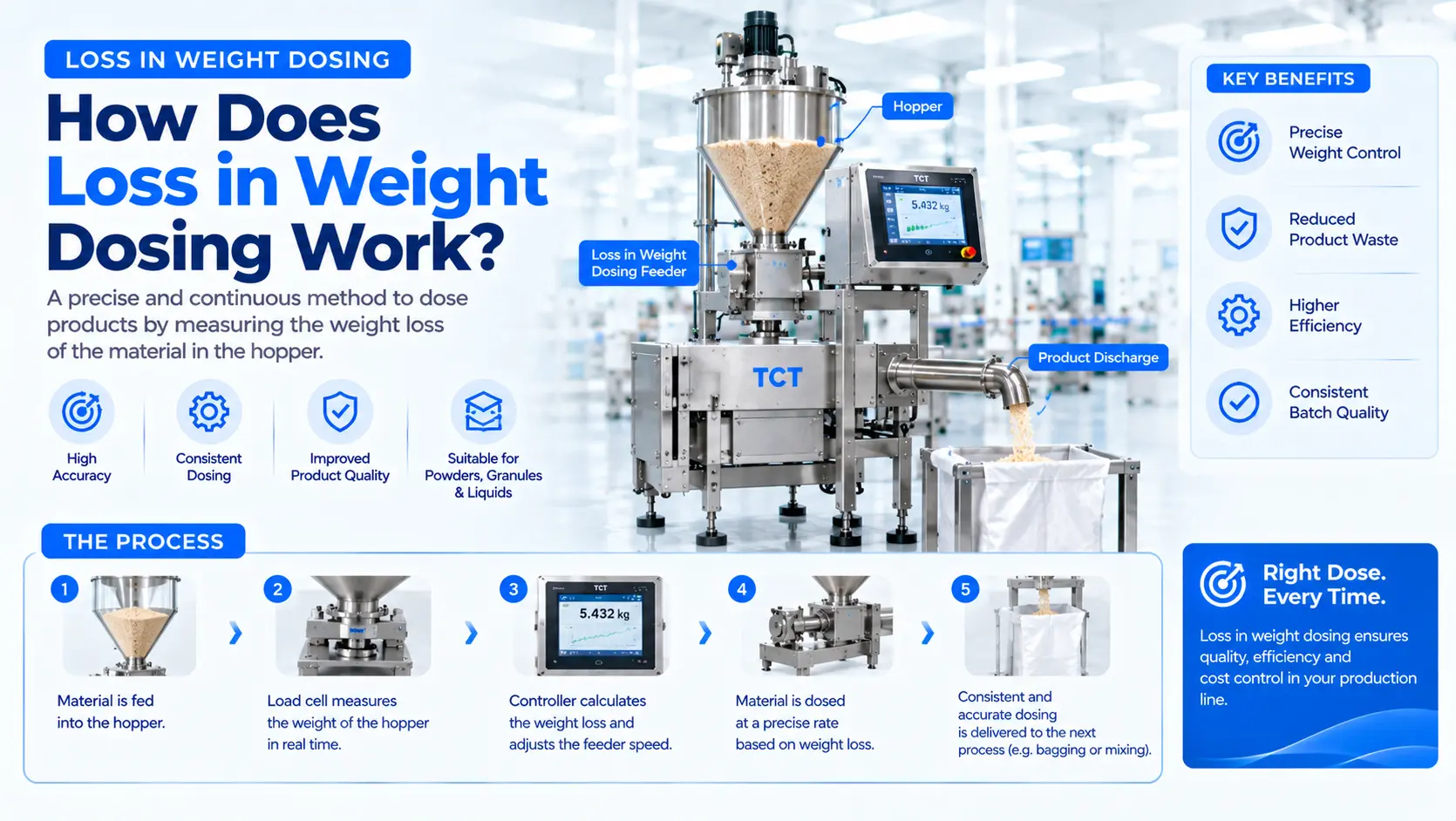
A loss-in-weight feeder weighs the entire feeder (hopper, material and screw) on load cells, many times a second.
- The hopper is filled with material and the system records its weight.
- The screw starts feeding material out.
- The controller measures how fast the total weight is falling: the "loss in weight".
- That rate of weight loss is the actual feed rate, for example 5.0 kg/h.
- If the actual rate differs from the set-point, the controller changes the screw speed to correct it.
This is called the negative weighing principle. TCT's Dosing System – Weigh in Loss System (TWL series) works exactly this way. It uses either a platform load cell or a three-point load cell system with a high-sensitivity strain gauge, and adjusts screw speed in real time to hold the set-point. Larger models can use a positive displacement transfer pump
instead of a screw.
[Insert diagram of an LIW system: refill valve → hopper with agitator → dosing screw → discharge, all mounted on load cells, with the controller loop shown.]
The refill phase
A loss-in-weight feeder has one weak moment: the refill. While the hopper is being refilled, the weight is going up, not down, so the controller cannot measure the feed rate from weight loss.
Good systems handle this in three steps:
- Before refill: the controller notes the screw speed that was giving the correct rate.
- During refill: it switches to volumetric mode and holds that speed (or a learned speed curve) for the few seconds of refill.
- After refill: it returns to gravimetric control once the weight is stable again.
To keep refill short and accurate:
- Refill quickly, from a well-designed valve or vacuum receiver above the hopper.
- Refill at a fixed low level, so the screw always sees similar head pressure.
- Avoid refills during critical process moments where possible.
A Powder Vacuum Transfer System or a Screw Conveyor is often used to refill LIW hoppers automatically.
Factors that affect accuracy
Many things affect how close a loss in weight feeder gets to its rated accuracy:
Factors that affect accuracy
Many things affect how close a loss in weight feeder gets to its rated accuracy:
- Material flow: sticky, cohesive or bridging powders feed unevenly. Agitators help; TCT's TWL-10 includes a stirrer.
- Vibration: nearby mixers, mills or compressors disturb load cells. Isolate the feeder and use anti-vibration mounts.
- Air pressure changes: connecting hoses and vents can push or pull on the hopper. Use flexible connectors.
- Screw selection: the screw size and pitch must suit the feed rate. A screw running too slowly or too fast loses accuracy.
- Refill strategy: as explained above.
- Calibration: check with test weights on a regular schedule.
TCT's TWL feeders are specified at ±0.5% to ±1% accuracy depending on application, with coarse and fine flow modes through variable screw speed.
Choosing a system
Ask these questions before you choose a loss in weight feeder:
Choosing a system
Ask these questions before you choose a loss in weight feeder:
- What feed rate range do you need? TCT's TWL-10 covers 1–10 kg/h with a 35 L hopper; the TWL-5, TWL-50/75 and TWL-100 cover other ranges.
- How does the material flow? Free-flowing granules are easy; cohesive powders may need agitation or a different screw.
- What accuracy does your recipe need? Compare with the realistic ±0.5–1% band.
- How will you refill? Manual, vacuum, screw or gravity.
- How will it be installed? TCT's TWL-100 can be floor-mounted or suspended from overhead structures.
- How will it connect to your controls? TCT's TWL series supports PLC integration.
- What hygiene standard applies? Pharma and food need easy-clean, GMP-friendly contact parts.
Check: confirm feed rate ranges for TWL-5, TWL-50/75 and TWL-100 and contact-part materials with TCT engineering before publishing.
Frequently asked questions
What is a loss in weight feeder? A gravimetric feeder that weighs its own hopper continuously and uses the rate of weight loss to control feed rate.
How accurate is loss-in-weight dosing? TCT's TWL series is specified at ±0.5% to ±1%, depending on material and application.
What is the difference between volumetric and gravimetric feeding? Volumetric feeders control volume and drift with density changes. Gravimetric feeders measure weight and correct automatically.
What happens during refill? The feeder switches briefly to volumetric mode, holding a known screw speed, then returns to gravimetric control.
Why are LIW feeders used in continuous manufacturing? Continuous lines need a steady, accurate ratio of each ingredient. LIW feeders provide that in real time.
Get the feed rate right
Talk to a TCT application engineer about which technology fits your product.