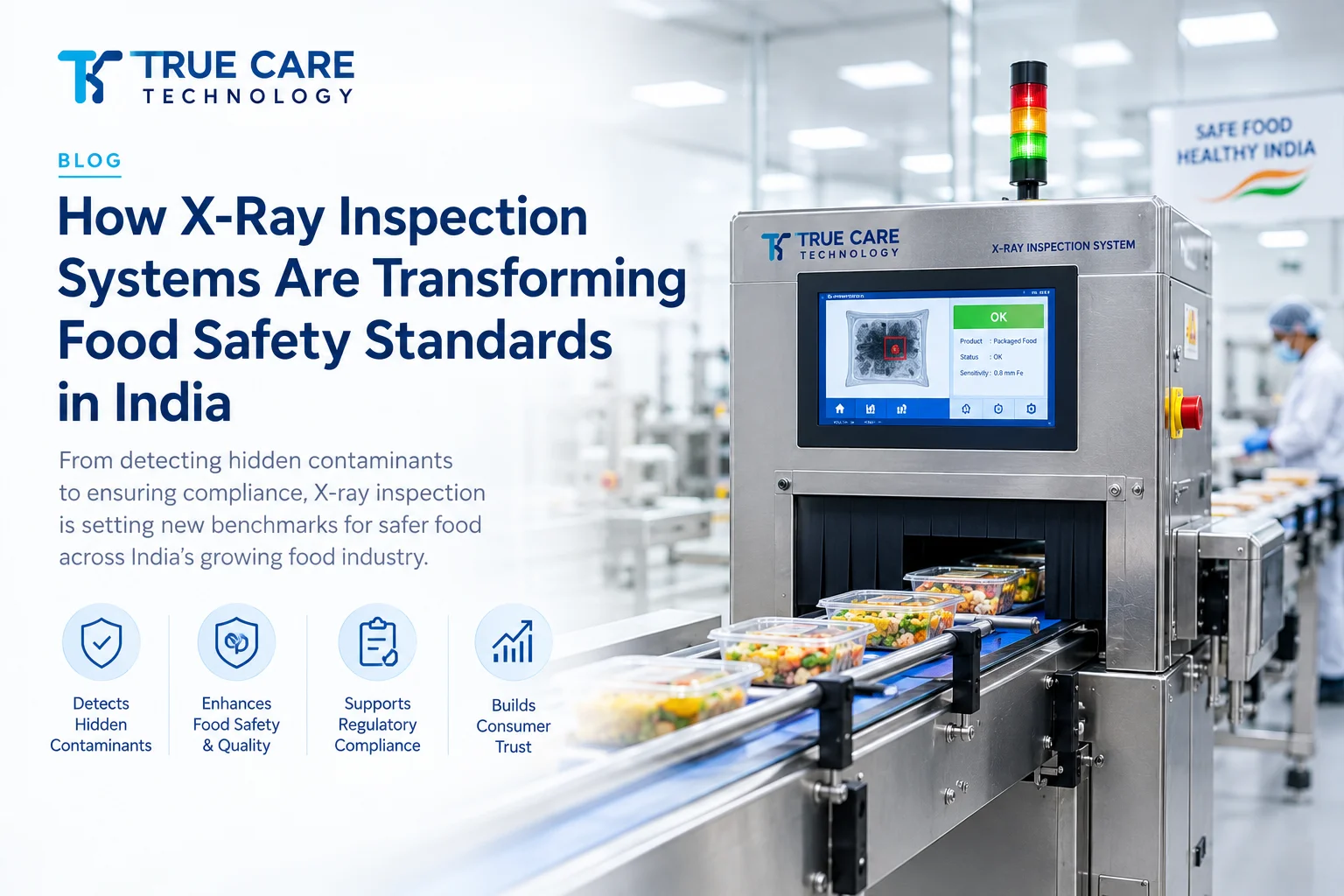
From detecting hidden foreign objects to improving production-line quality control, X-ray inspection is becoming an important technology for food manufacturers looking to strengthen food safety and product integrity.
India's food-processing industry is becoming increasingly automated. Packaged foods, ready-to-eat meals, snacks, bakery products, dairy products, frozen foods, spices, grains and other processed products are moving through high-speed production and packaging lines.
As production speeds increase, manufacturers need inspection technologies that can identify contamination and product defects without slowing down the production process.
This is where X-ray inspection systems can play an important role.
Unlike conventional visual inspection, X-ray inspection analyzes the density of products and can identify certain foreign objects hidden inside the product or packaging. Depending on the application, X-ray systems can detect contaminants such as metal, glass, stone, bone, hard plastic and ceramic, while also supporting other quality checks.
Why Is X-Ray Inspection Important for the Indian Food Industry?
Food contamination can occur at different stages of manufacturing.
Foreign objects may enter a production process through:
- Raw materials
- Processing equipment
- Broken machine components
- Packaging materials
- Glass containers
- Stones or other environmental materials
- Equipment wear
- Damaged or deteriorated components
Traditional visual inspection may not be sufficient when the contaminant is inside an opaque package or embedded within the food product.
X-ray inspection provides an additional automated inspection layer that can examine the product without opening the package.
This makes the technology particularly useful for packaged foods where the product cannot be visually inspected after sealing.
How Does an X-Ray Inspection System Work?
An X-ray inspection system passes a controlled X-ray beam through the product while it moves along a conveyor.
Different materials absorb X-rays differently depending on their density and composition.
The system's detector captures the resulting image and software analyzes it for abnormalities.
The basic process can be represented as:
Product → X-Ray Generation → Image Capture → Image Analysis → Contamination Detection → Automatic Rejection
When a potentially contaminated product is identified, an integrated rejection mechanism can remove it from the production line.
Modern systems can also provide real-time product imaging and production data to help operators monitor the inspection process. True Care Technology's TXR systems, for example, provide real-time imaging, automated contaminant detection and production data logs.
What Can X-Ray Inspection Detect?
One of the major advantages of X-ray inspection is its ability to identify a broader range of dense foreign materials than conventional metal detection.
Depending on the product and system configuration, X-ray inspection can detect:
Metal
X-ray systems can identify metallic contaminants, including ferrous and non-ferrous metals.
Glass
Glass contamination can be particularly difficult to identify through conventional visual inspection when the contaminant is inside a sealed package.
Stone
Stone and other dense mineral materials can be identified based on their density difference from the surrounding product.
Bone
Food products such as meat and poultry can benefit from X-ray inspection for certain bone-related contamination risks.
Hard Plastic
Some high-density plastics can be identified by X-ray systems where conventional metal detection would not be appropriate.
Ceramic
Ceramic fragments can also be detectable when their density and size provide sufficient contrast.
True Care Technology's standard X-ray systems are designed to inspect for metals as well as glass, ceramic, stone, bone, hard rubber and hard plastic.